Nov 14, 2013

Update 11/16; Powerful Storm to Bring Damaging Winds and Likelihood of Severe Weather Into The Great Lakes Sunday

Update 11/18
Severe Weather Report from the NWS DTX for 11/17-18


Update 11/16

All guidance continues to show a powerful storm to impact the Great Lakes Sunday into Monday. Look for the biggest impacts to be by way of strong winds and the more likelihood of severe thunderstorms Sunday afternoon and evening. A deepening and intensifying low pressure system will cross the upper Mississippi Valley into the northern Great Lakes by Sunday evening. The deep low will pivot a strong cold front through Southeast Lower Michigan by evening with an increasing risk of severe weather out ahead of the system Sunday mid afternoon into early evening.  The dynamics of the system are powerful and easily could produce severe weather. The possible negating factor is how much instability will be available for the storms. That being said; the powerful upper air dynamics will not need much to make the most of what  instability is available. So much so; there is even the risk of tornadoes with strong cold front later Sunday into Sunday evening due to the strong veering winds with height; therefore spin-ups in the atmosphere are a distinct risk! While time of year is also a negating factor; all one has to do is think back to November 2002 to see what severe weather is attainable under prime conditions! While that severe weather and rash of tornadoes occurred across Ohio and Indiana and points south; it does show what is possible at this time of year!. Stay tuned to the NWS for possible Severe Weather Watches and Warnings on Sunday.

Sharply colder air will sweep behind the strong cold front Sunday Night into Monday. Look for temperatures to rise into the 60s ahead of the front Sunday and plummet down to the 30s by Monday morning; only to recover or hold steady in the upper 30 to lower 40s Monday afternoon.

Severe Weather Outlook from The Storm Prediction Center


Day One

11/14
Recent model projections are bringing together a strong low pressure system into the northern Great Lakes late Sunday into Monday. Variances on just how strong she'll be still have to be worked out but at this time projections are for a Kansas Low to intensify quickly later Sunday as she tracks quickly northeast into the northern Great Lakes by early Monday. Some modeling has the storm deepening down into the 975 MB range by the time she matures over the northern Great Lakes. While this looks to be a bit strong, pressures dropping to around  980 MB are quite possible by Monday.

This storm has the potential to bring strong winds, heavy rains and wrap around snow in the colder air behind the system. The storm will intensify as she draws very cold air from southern Canada into the Great Lakes. The cold air will sweep Southeast Lower Michigan in the form of a powerful cold front by later Sunday afternoon and evening bringing heavy rain and possible even a few thunderstorms. Much colder air will blast the region Sunday night into Monday with temperatures dropping through the 30s Sunday night and into the 20s by Monday morning. Look for a further update as things become clearer on this storm into the weekend.


Making weather fun while we all learn,
Bill Deedler -SEMI_WeatherHistorian

Nov 13, 2013

If You Think It's Been Cold Lately..

...Take a Look at the Cold Blast of November 1880!


Record November Cold Wave Holds Steadfast For Well Over a Century


Nothing in Southeast Michigan ’s record books has anything close to the record cold wave that occurred so early in the cold season than way back in the late 19th century in November 1880, or 133 years ago! The bitter cold surges blasted Southeast Lower Michigan from the 18th to the 23rd from the Arctic region and engulfed much of the country. The Arctic chill came down in the form of two impressively strong Arctic high pressure systems (see maps below) for mid winter, let alone mid November. 
 
Below is the record chart for that period that contains both the record low maximums and record lows that occurred during the November cold wave which left six days of records that have not been touched since! The three degree reading on the 21st and zero on the 22nd have yet to be superseded by colder temperatures in the entire month of November. A zero (or below) record low does not appear in Detroit ’s record lows for another 10 days when a -2 was recorded on December 2nd, 1976!   


Again, not only is the cold impressive but that both the record low maximums and the record lows have not been breached since this cold wave. The six days of record breaking cold remains intact since 1880!  So what caused this bone-chilling cold so early in the season, what did the weather maps (or best representation of) look like so far back? Let’s take a look at copies of the archaic weather map records from Nov 18-23, 1880 which shows the couple of mammoth Arctic high pressure systems that affected much of the during the period.  


As of 7AM - Thu  Nov 18th  Note the first big chunk of cold dense air is well reflected by the exceptionally high pressure for November (not to mention over the southern states) in eastern Oklahoma of 30.78" /1042.MB/  (just at the bottom edge of our map).  This massive Arctic high made its way south out of the Northern Plains and as a result, temperatures across much of the region were in the single digits and teens.


As of 11PM - Nov 19th   By late Friday night, a new surge of Arctic air is beginning to show its face here as a new low pressure trough enters the Upper Midwest and Great Lakes Region. Note, temperatures haven’t had a chance to recover much from the first bitter cold blast!


As of 11PM - Nov 20th   The second surge of fresh Arctic air continues advancing across the Great Lakes and Ohio Valley as general high pressure holds over the southern states.


As of 11PM - Nov 21st   A second, duplicate strong high pressure appears on our map, once again by way of the Northern Plains and expands south and east into into the Upper Mississippi Valley and Great Lakes. Low pressure troughing holds sway over the relatively warmer waters of the Great Lakes (estimates of water temperatures in the mid 30s to mid 40s). Temperatures have plummeted below zero already in the Upper Mississippi Valley by late Sunday night.


 As of 11PM - Nov 22nd   A huge bitter cold high pressure lies spralled across the Ohio Valley and Great Lakes with a central pressure of 30.85" /1045 MB/! The public continues to be greated by record cold as the Thanksgiving work week commenced across the nation. The 30.85" was a record high pressure at the time (and may be yet) for Cincinnati, Ohio. Besides our own,  numerous other record lows were attained with the passage of these Arctic highs.


As of 11PM - Nov 23rd  The large high pressure moves ever so slowly east with the central high pressure now over the mid Atlantic States.

Evidently this was not the first notable November cold snap that engulfed the region so early in the weather record days. The following was taken from the 1880 Monthly Weather Review:  
 
"The passage of of this area was marked by minimum temperatures for the Lakes region, the Atlantic States,  the Ohio, Upper Mississippi and Lower Missouri valleys. They occurred from seven to eight days earlier in the month than the remarkably low temperatures of 1875. The most notable temperatures observed at the Signal Service Stations were Washington, 12.5;  Philadelphia, 10;  St. Louis and Louisville, 8;  Pittsburgh, 4;  Buffalo, 3;  Chicago, 1;  Erie, Detroit, Sandusky, Grand Haven and Des Moines, 0;  Champaign, -3;  Alpena, -4;  Columbus, Indianapolis, Keokuk and Milwaukee, -5;  Port Huron, -6;  Marquette, -9."
 
As mentioned, it looks like (but it's been cold, so you never know) all the Detroit records will remain intact 133 years later in 2013 and I wonder how many others are still around at other offices? 

 Making weather fun while we all learn,
Bill Deedler -SEMI_WeatherHistorian

Nov 4, 2013

100TH Anniversary of the Great Lakes "White Hurricane" - The Great and Destructive Storm of 1913!


One of the most memorable and rewarding  articles I researched and wrote while
employed by the National Weather Service had to do with the unprecedented and
destructive Fall Storm of 1913. On this 100th anniversary of this storm, many Great
Lakes and Weather Historians still agree that this storm was the greatest synoptic 
storm in modern history to blast the Great Lakes! 

"HELL HATH NO FURY LIKE A GREAT LAKES FALL STORM" 
 CENTENNIAL ANNIVERSARY OF THE  GREAT LAKES WHITE HURRICANE -
 NOVEMBER 1913
 
 By: William R. Deedler, Weather Historian, Southeast Lower Michigan

Anyone living in the Great Lakes Region for an extended period of
time can become all too familiar with the incredible storms, or
low pressure areas, that can settle over the Great Lakes Region
in the fall. November, being the prime month for such monsters to
start materializing, has had more than its share of super storms.
As Polar outbreaks become more regular and intense, surging south
into the area, they meet up with the warmer, moisture laden air
from the Gulf of Mexico. Add to this a roaring jet stream with
lots of energy and you have the ingredients for dynamic storm
development.

While this occurs with some regularity during fall and winter
months in the Great Lakes, there are probably a dozen or so 
mammoth storms which are noted in history for their severity,
creating extensive losses in life and property, particularly to
the shipping industry. While controversy may exist about which
storm was the strongest and produced the most devastation, one
could hardly deny that the fall storm of November 7-12th, 1913
ranks near or at the top! In fact, it is generally agreed that
the November 1913 storm (which concentrated more on Lake Huron
for its death and destruction) was the greatest ever to strike
the Great Lakes. No other Great Lakes storm even begins to
compare in modern history with its death toll of 235 lives
(possibly more, as ship personnel records back then weren't the
best) and up to forty shipwrecks. Of these wrecks, eight were
large Lake freighters that sank below Lake Huron's stormy
surface, taking all hands with them.

The November 1913 weather map pattern of storm development was
ironically, not unlike the storm development of another, more
recent monster low pressure system that formed during the period
of January 25-27th, 1978. Both systems involved an Arctic shot of
cold air moving south across the Lakes area, while at the same
time, an intensifying low pressure area took shape over the
southern Appalachians. In both cases, it was this low center that
became the powerful storm as it tracked north northwest from the
southern Appalachians into the eastern Great Lakes, absorbing the
Arctic air in place. As the Arctic air was drawn into both
storms, rapid intensification took place. (For the more
meteorologically inclined...In the 1978 storm, an incredibly
intense negatively tilted 500 mb trof formed as the Arctic jet
stream phased with the subtropical jet over the eastern half of
the U.S. Though I was unable to locate the 500 mb map from the
1913 storm, the surface development and trajectories of the
systems show a nearly identical upper wind pattern). Both low
pressure systems deepened tremendously ("bombed out") to record
low pressures for their time. The 1913 storm's central pressure
dipped to around 28.60 inches (968.5 mb), while the 1978 storm
intensified to an almost unbelievable 28.20 inches (955 mb)! 

There were a couple of big differences, though, between the
storms. First, and most obvious, one occurred in the mid fall,
while the other was in mid winter.  Second, and more importantly,
the November 1913 storm was much more destructive to the Great
Lakes shipping industry, being that the lakes were still open
(ice free) and it contained a ferocious wind that howled for a
longer period. Therefore, I decided to dig way back in the
weather and Great Lakes history books and write about the
November 1913 storm. (At this time, I plan a more extensive
write up on the January 1978 storm late January 1997).

As stated earlier, the storm of November 1913 began as two
separate systems.  A rather weak low pressure system tracked
east across the southern U.S., November 6th through the 8th,
while a low pressure area and associated Arctic front moved south
out of Canada and approached the northern Great Lakes by Friday
morning, the 7th. The air behind this front was very cold for
early November with temperatures plunging into the single figures
across the Northern Plains. In addition to the cold temperatures,
a strong southwest wind blew out ahead of the Arctic front, while
a strong northwest wind followed it. A storm warning was issued
for the Great Lakes Friday morning at 1000 am because of the very
strong winds expected ahead of and behind the Arctic front. A
large dome of high pressure (30.52 in) was well behind the front
at the core of the cold air, extending from southwest Canada,
south into the northern Rockies. As the low pressure and
attendant Arctic front moved across the Great Lakes on Saturday,
storm force winds gusting 50 knots or better did indeed buffet
the Great Lakes while shifting from southwest to the northwest.
Weather observations at Detroit on Saturday, the 8th, also showed
southwest winds averaging 25 to 35 mph with gusts 35 to 40 mph,
shifting to the west. Temperatures which started in the 50s in
Detroit on the 8th, fell to the lower 30s by midnight. Meanwhile,
winds over the Great Lakes were reported occasionally gusting
better than 50 knots, especially over Lake Superior and were
accompanied by snow squalls and blizzard like conditions. But the
worse was yet to come...

By Sunday morning, the Arctic front continued to push southeast
through the Ohio Valley, while at the same time, our storm center 
in the Appalachians was beginning to crank up and intensify
(29.10 in) over northern Virginia. It was during the day, Sunday
the 9th, that things really began to come together. The northern
and weaker low pressure system (with associated Arctic airmass
over the Great Lakes and Ohio Valley) was pulled into and
absorbed by the stronger, intense low pressure system over the
Virginia. As the much colder air fed into system, the storm began
backing to the north-northwest toward its cold air supply,
becoming a meteorological monster, growing and feeding on the
moisture from the Atlantic and mixing it with the Arctic cold
across the Great Lakes. 

By Sunday evening, our storm deepened to a very intense central
pressure of about 28.60 inches as it tracked north-northwest
to eastern Lake Erie near Erie, Pennsylvania. At the same time,
the strong Arctic high pressure (30.54 in) was approaching
northwest Minnesota. The isobaric pressure pattern between the
two strong systems must have been very tight, given the extremes
in pressure and thus, created even stronger storm force winds
across the Great Lakes. Storm Warnings continued to fly over all
the Great Lakes as northwest winds of extreme velocity backed to
the north and churned the waters viciously. An extensive area of
snow and blinding snow squalls developed across the Great Lakes
as the Arctic cold blasted its way across the Lakes. Snow began
falling Sunday evening in the Detroit area with about 3 inches
on the ground by midnight and only 4.3 total. Much of this snow
though, was due to "wrap around or backwash precipitation"
produced on the backside of the storm and not Lake effect with
the north-northwest wind trajectory. Eastern areas of the Great
Lakes didn't fare as well and got hammered by snow and snow
squalls as the Arctic cold blew across the relatively warmer
waters of the Great Lakes. (In fact, the Fall weather previous to
this storm had been mild and Great Lake temperatures were most
likely warmer than normal). This, combined with the intense storm
center, buried the Lake effect communities with at least a couple
of feet of snow and HUGE drifts. Port Huron, which usually gets
Lake effect snow from Lake Huron with mainly a northeast or north
wind, got buried with heavy snow and snow squalls creating 4 to 5
foot drifts which immobilized the city. Other areas in the "snow
belt" communities had similar reports including Cleveland, which
was paralyzed with about 2 feet of snow, NOT including drifts.
The record at Cleveland up to that time for a snowfall in a 24
hour period was shattered with 17.4 inches falling (previous was
13.0 in). Several reports of wires and telephone polls being
pulled down were received due to the combination of heavy snow,
ice and incredible winds.

Records show that the wind at Port Huron, at the base of Lake
Huron, increased steadily during the day on the 9th with maximum
winds averaging 40 to 50 mph early Sunday afternoon, increasing
even further to 50 to 60 mph later that afternoon and continuing
to almost midnight. A maximum wind of 62 mph was recorded at
902 pm at Port Huron with similar readings at Harbor Beach.
In Detroit, the northwest wind increased through the day to an
average wind of 45 mph between 700 and 800 pm with an extreme
gust of 70 mph recorded at 715 pm. Keep in mind, these readings
were on land (not sea) but the violent weather experienced over
the Great Lakes was well documented. It was best summed up in 
a report by the Lake Carriers Association in the wake of the
Great Lakes " white hurricane":

"No lake master can recall in all his experience a storm of
such unprecedented violence with such rapid changes in the
direction of the wind and its gusts of such fearful speed!
Storms ordinarily of that velocity do not last over four or
five hours, but this storm raged for sixteen hours continuously
at an average velocity of sixty miles per hour, with frequent
spurts of seventy and over.

Obviously, with a wind of such long duration, the seas that
were made were such that the lakes are not ordinarily acquainted
with. The testimony of masters is that the waves were at least
35 feet high and followed each other in quick succession, three
waves ordinarily coming one right after the other.
 
They were considerably shorter than the waves that are formed
by an ordinary gale. Being of such height and hurled with such
force and such rapid succession, the ships must have been
subjected to incredible punishment!"

It went on to say that the storm was so unusual and unprecen-
dented, that it may be centuries before such a storm would be
experienced again. As stated earlier, approximately 235 people
lost their lives on the ships with most of them from the eight
large freighters (for that time) sunk on Lake Huron. They include
the John McGean, Isaac M. Scott, Argus, Hydrus, James Carruthers,
Wexford, Regina and Charles S. Price. Most sunk over central and
eastern Lake Huron, in Canadian waters. Horrific stories of dead
sailors being washed ashore during the days following the storm
came from Southern Ontario, along the lakeshore primarily from
Southhampton, south to Kettle Point and Port Franks. This area
included the larger communities Port Elgin, Kincardine and
Goderich and roughly extended across the Lake from Oscoda to
Port Huron in Michigan. A farmer, along the Canadian shoreline,
told how the first dead body came floating ashore, "announcing"
the arrival of the grisly scene to follow. It was truly an eerie
and ghastly sight when, out of a dense fog, he saw a man bobbing
in the water with his arms stretched out as though he were waving
to him! It was a sailor from the Wexford and his shipmates
quickly followed. The scene of bodies floating to shore was like
out of some horror movie script in the book by Robert J. Hemming
titled, "Ships Gone Missing." In it, he graphically describes
the ghastly sight in the thick fog...

"Singly and by twos and threes they drifted in, as if coming
to be present at some ghastly muster, shrouded in life jackets
bearing the names of ships gone missing. The Wexford, Argus, 
McGean, Hydrus, Scott, Regina, Carruthers and Price had all
sent representatives to shore to announce to everyone that they
foundered, that their crews were all dead. Stiff, bloated and
battered, their heads capped in ice, they floated in, rolled
and pitched by the combers crashing on the beach.

They came draped over life preservers, they came wrapped in
each others arms, they came frozen together in clusters. All
week long they came, to be collected by area farmers who some-
times had to dig half-buried bodies out of the sand that was
trying to cover them."

It's sad to say, that even with the horrible outcome of those
sailors and the grief their family and friends endured, some
looting of the bodies and cargo from the ships quickly became a
problem. The local police were notified and they, along with the
Sarnia police, enforced a stiff fine and up to 3 years in jail if
caught looting. News quickly spread of the mass graveyard along
the Canadian beach and scores of relatives and friends of the
sailors came and identified the bodies. Unfortunately, after
a few days, a change in the wind and lake currents caused some
bodies to drift back out into the lake, never to be found.

Some strange tales also arose from this tragedy, such as, the
sailor who washed ashore from the Charles S. Price...with a
life preserver from the Regina! This spawned a rash of theories
on how it got there. Did the ships collide and thus, some men
from the Price were rescued by the crew of the Regina...only
later to go down herself?  Or, where they (Regina crew) unable to
rescue the men but still threw them life preservers? Another 
possibility, maybe the life preserver just floated in after the
sailor and ended up on top of him. Another tale surrounded a 
unidentified sailor with the initials J.T. on his arm. After
reading about it in the paper, Mrs Edward Ward, telegrammed her
father, Thomas Thompson of Hamilton, Ontario, telling him his son
(her brother) John, must be the unidentified man. John Thompson
had been on the Carruthers, like the unidentified man and also
had a tattoo with the initials J.T. on his arm. Therefore, Thomas
rushed to the funeral home to identify the body. The body was
badly battered but the facial features, similar to John's, were
still largely recognizable. Other similarities were compelling,
the feet had crossed toes, just like John's, the tattoo was on
the left arm, like John's and a scar on the nose and leg matched
John's perfectly. Not to mention, the body's teeth had the same
teeth missing as John's! There was, however, a puzzling fact that
didn't match...the hair color. The corpse's hair was light brown,
while John's was almost black! The undertaker dismissed this
fact, figuring the body, being immersed in cold water for a long
time could have caused the hair to be lighter. In light of all
the remarkable similarities, they went ahead with the funeral.
You guessed it, it wasn't John. Right in the middle of John's
memorial service, in walks John! You could have knocked over the
mourners with a feather as they stood there, stunned as the
resemblance was uncanny! Evidently, John had jumped ship to be
on a ship called the Maple and waited out the storm in Toronto,
where he read about his "death." Thinking it would be a real good
joke, he said nothing to his family and friends and thus, walked
in on his own funeral!

The unidentified man, remained so and was buried with four other
anonymous souls. All together, only 56 bodies would be recovered
on Canadian beaches along with one near Port Sanilac, Michigan.

And talk about ESP... another seaman, Milton Smith, having been
bothered by persistent bad premonitions or a foreboding of
something terrible happening to him if he stayed aboard the
freighter Price, just up and left. He told his superior officer
of the foreboding he felt, who in turn, tried to persuade him to
stay for the remaining three weeks. No way, Milton was more
determined than ever and left at his shipmates scoffs. Well,
you know the rest of the story...

Epilogue: I wish to dedicate this internet story to all the 
          Great Lakes shipping personnel, past and present.
          To their hard work and difficult lifestyle they must    
          lead...and dangerous weather they encounter. To all the
          men who have died in shipping tragedies, especially in
          this 1913 storm and those aboard the Edmund Fitzgerald, 
          which went down in Lake Superior on a Monday evening at 
          approximately 715 pm, November 10, 1975. The Fitzgerald 
          was a magnificent freighter that I watched through my   
          childhood as it pushed north and southbound on the
          St. Clair River past Marine City, Michigan.

          Finally, I'd like to dedicate this article to my        
          deceased Grandfather, William Leo Deedler. Who, 
          during the first half of this century, worked for       
          several years on the freighters as a Chief Engineer,
          and to my Grandmother, Adelaide, who put up with it!   
 
Criteria for advisories/warnings on the Great Lakes

     Headline                        Criteria
                                             Wind (knots)

Small Craft Advisory          18 to 33
Gale Warning                       34 to 47
Storm Warning                    48 or greater
__________________________________________________________ 

On the 100th anniversary of this great storm, the National Weather Service has
worked on a ever encompassing tribute to the storm! A wide range of topics were
researched and put together by a number of Great Lakes offices in the 
 "Centennial Anniversary Storm of 1913"   
Check out the site; one of my favorites is; A Numerical Model Retrospective.
Making weather fun while we all learn,
Bill Deedler -SEMI_WeatherHistorian


Oct 12, 2013

Update; 10/17/2013 - Beautiful Mild Autumn Weather Will Come to an Abrupt End By Late Next Week! Also; Recent notable October Cold Blasts!

10/17- Update
No change in the outlook as much colder air will dump out of the Polar Region through the next week or so; beginning this weekend. There will be the risk of a frost, freeze and even rain/snow showers with the abrupt change in the jet stream. Frost and freezes will greatly depend on sky and wind conditions as the atmosphere will certainly be cold enough at some junctures to support it.
_________________________________________________________________________________________
10/12/13

October has been mainly a beautiful warm month thus far across much of the Great Lakes region including Southeast Lower Michigan. Temperatures across Southeast Lower Michigan thus far in October will have averaged a good 7 to 9 degrees above normal by the end of this weekend; but this will change come later next week. Colder air of Polar origin has been charging up across that region and indications have been for several days now it will begin to trek south by this upcoming mid-late week  period /16-18th/ toward the Lakes. All indications show a cross polar dive of cold air into the eastern half of  North America as ridging builds over the west, This change has been intimated for days in the NAO into next week with a dive into negative territory.


This first wave of cooler air will arrive mid week and be accompanied by showers and possibly a few thunderstorms later Tuesday into Wednesday. After this, the drop temperatures will fall back closer to more typical October readings for mid month across all of Southeast Lower Michigan; mid 50s to near 60 for highs and mid 30s to lower 40s for lows.
 
The real interesting colder shot of air is slated to arrive on heels of the first by Friday into next weekend (18 -19th) with a re-enforcing shot later over the weekend. This cold air will likely bring our first widespread frost and/or freeze depending on air coldness, sky and wind conditions. Therefore, this is a heads up on a widespread frost/freeze risk for Southeast Lower Michigan! There is even the chance of some snow showers with this system if projections hold true to form.


Note; I said interesting shot of colder air next weekend for another reason; one of meteorological models has been insisting on developing a brute of an October storm over next weekend on the tail end of the second wave of colder air. The general storm track of this system has been from the Lower Mississippi Valley /Arkansas area/ to the Eastern Lakes region /SE Mich/SW Ontario area/ the last few runs (see below).  Earlier, it developed this storm track further west over the southern Midwest to eastern Upper Michigan. This will have to be watched to see if this is a figment of the Euro's imagination or not; at this time the development and strength of this system looks quite suspect, however the Euro tends to be the better models for later periods!  We shall see...


In any event, the third week of October does not look nearly as nice as the first two weeks. As this radical change in our weather pattern develops; I'll update this outlook.


Looking back over the past decade or so, here are many October cold blasts I wrote about....

Just last October 2012

10/8 Update; A Cold and Frosty Columbus Day Greets Inhabitants of Southeast Lower Michigan

Widespread frosts and areas of freezing temperatures engulfed Southeast Lower Michigan this Columbus morning under brilliant sunshine. Before that sunshine, temperatures dropped well down into the 20s and 30s at most locations. As would be expected; sheltered areas along with lake influenced areas escaped the worst of the cold. Check out the low temperatures on the NWS regional temperatures/precipitation table. Keep in mind the second table of several; reflects 24 hour low temperatures ending at midnight. Coldest temperatures were found around the Saline area where readings crated to the lower 20s!

October 2006 

The most dismal weather seemed to come at the peak autumn color show across the region. No doubt the worst of weather in October (and likely the fall) came mid-month on the 12th with a record breaking cold blast of Arctic air. The storm had an uncanny resemblance to very old record setting storm itself, back on October 13th, 1909. Both systems contained impressively deep centers / around 29.00”/ and air straight out of cold core depths of the Arctic. They also took similar tracks and blasted same region with heavy snow, lake effect snow and again, exceptional cold for October. Blustery heavy snow showers bombarded the land with visibilities, at times, dropping to white out conditions.

Then in OCTOBER 2004 

NEAR RECORD COLD FIRST WEEK OFFSET BY INDIAN SUMMER WEATHER THE LAST WEEK

October had been a cool month, especially in the beginning when temperatures fell into the mid 30s with several mornings during the first week having some frosty conditions. A low of 35 degrees on 5th at Detroit Metro - and 25 degrees here at White Lake - was accompanied by a killing frost and hard freeze in Detroit's north/west suburbs. Later on the 17th/18th, another plunge of polar air brought temperature back down into the 30s and for the most part, ended the growing season for 2004 across the remainder of Southeast Lower Michigan. Big changes in the upper wind flow to a predominant southwest flow took place during the last third of the month and brought much warmer weather to the region. Temperatures pushed well up into the 60s throughout the last week of the month and peaked at 75 degrees on the 30th (second highest tem

October 2003
October opened in the depths of some of the unseasonably cold air that arrived late in September. A strong polar high pressure pushed the cold air south into the area from Northern Canada. So cold was it on the 1st, that several locations noted snow flakes mixed in with rain showers. While that was the case here at the NWS in White Lake, it was not officially at Detroit Metro Airport. If snow had been observed there, it would have tied the earliest date for snowfall officially observed at Detroit /Oct 1st 1974/. The chill hung around for the nearly the entire first week of the month. High temperatures held down in the 50s, while lows fell into the upper 20s to upper 30s. 

 OCTOBER OF 2002 
WILL BE REMEMBERED ACROSS SOUTHEAST LOWER MICHIGAN FOR ITS NOTABLE CONTRASTING TEMPERATURE PATTERN. THE MONTH ARRIVED LIKE SEPTEMBER ENDED WITH UNSEASONABLY WARM WEATHER PRODUCING RECORD OR NEAR RECORD WARMTH. A HIGH TEMPERATURE AT DETROIT METRO AIRPORT OF 86 ON THE 1ST CAME WITHIN 2 DEGREES OF THE RECORD /88/. THAT HIGH OF 86 CHALLENGED BUT WAS UNABLE TO BREAK THE RECORD HIGH THAT CONTINUES TO STAND FOR OVER A CENTURY...SET WAY BACK IN 1897. THE LOW OF 66 AND AVERAGE TEMPERATURE OF 76 WERE...HOWEVER...THE WARMEST TEMPERATURES EVER SEEN ON OCTOBER 1ST. ANOTHER HIGH IN THE 80S /81/ CAME ON THE 4TH AND WAS A GOOD 15 DEGREES ABOVE NORMAL. THE SUMMER-LIKE WEATHER WITH TEMPERATURES IN THE 80S WAS ENDED ON THE 4TH BY A STRONG COLD FRONT THAT CHURNED-UP A SQUALL-LINE OF SHOWERS AND WIND GUSTS UP TO AROUND 45 MPH

 BIG CHANGE CAME MID MONTH AS THE UPPER WIND PATTERN SHIFTED FROM A DOMINANT SOUTHWESTERLY FLOW TO NORTHWESTERLY. THE COLDER SECOND HALF OF OCTOBER CAUSED THE AVERAGE TEMPERATURE TO DROP OVER TEN DEGREES TO 50 DEGREES BY MONTH'S END! THE WELL ABOVE NORMAL COOLING DEGREE DEPARTURE FOR THE MONTH...DESPITE THE BELOW NORMAL MONTHLY AVERAGE TEMPERATURE...FURTHER UNDERLINES THE CONTRASTING TEMPERATURE PATTERN OF THE MONTH. IN SPITE OF THE COLDER SECOND HALF OF OCTOBER...NO RECORD LOWS WERE SET. FROST AND FREEZES DID...HOWEVER...PRETTY MUCH ARRIVE ON SCHEDULE ACROSS SOUTHEAST LOWER MICHIGAN BY MID MONTH. THE FIRST FREEZING TEMPERATURE /30 DEGREES/ AT DETROIT METRO AIRPORT WAS RECORDED ON THE 14TH.


Making weather fun while we all learn,
Bill Deedler - SEMI_WeatherHistorian


Sep 18, 2013

Hurricanes in Michigan??? Along with...Hurroncane!

Originally written September 1999 & Updated September 2004/2012/2013 (see updated reanalysis information).

This week is the anniversary of one of the most unusual and intense wind storms ever to hit Southeast Lower Michigan. It was over seven decades /72-yrs/ ago on September 25th, 1941 when the remnants of a tropical storm hit the region. This storm by far, was not the usual remnants of tropical origins that occasionally make it up to the Great Lakes region but one of extraordinary circumstances for it truly was the Astonishing Storm of September 25th, 1941

At first glance, when one reads that headline, one might say, "What? Hurricanes here in the Great Lakes?? No way!" Of course you'd be right, no actual hurricane has ever been observed in Michigan under the true definition of a hurricane. The definition of a hurricane, according to the Glossary of Weather and Climate edited by Ira W. Geer, is as follows: "A severe tropical cyclone with maximum 1-minute sustained surface wind speed greater than 64 knots (74 mph) in the North Atlantic Ocean, Caribbean Sea, Gulf of Mexico and the Eastern North Pacific off the west coast of Mexico to the International Dateline. West of the Dateline they are known as typhoons." Furthermore, the definition of a tropical cyclone is as follows: "A generic term for a non-frontal synoptic-scale cyclone originating over the tropical or subtropical waters with organized convection and a definite cyclonic surface wind circulation." Clearly, neither definition applies in the Great Lakes area, although remnants of hurricanes that have become extra-tropical (loses its tropical characteristics) occasionally do make their way into the Great Lakes region.

Scanning over 80 years (since 1921) worth of hurricane track data suggests that remnants of a hurricane or tropical storm make their way into the Great Lakes region on an average of twice a decade, especially the southern Great Lakes area (see Table-1). Also, in the majority of instances, by the time they visit this region they have diminished to an area of rain with maybe some squally winds. There have been a few instances, along the way, however, that do bear mentioning, and ONE STORM in particular that screams for attention!

TABLE - 1

REMNANTS OF TROPICAL STORMS THAT HAVE AFFECTED THE GREAT LAKES AND SOUTHEAST LOWER MICHIGAN (SINCE 1921)
DATE (Storm's life cycle)
DETROIT RAINFALL/DATES (Inches)
MAXIMUM WIND (mph)
10/16-19 1923
.55 - 10/18
SE - 22
7/20-8/2 1926
1.11 - 8/1
E - 25
8/27-9/3 1932
2.95 - 9/3-4
NE - 21
9/10-22 1938
.23 - 9/21-22
SW - 20
9/16-25 1941
Trace - 9/25
SW - 52 *
9/1-6 1948
.82 - 9/6-8
N - 25
9/27-10/6 1949
1.30 - 10/6-7
SW - 21
Connie -
8/1-8/14 1955
.69 - 8/13-14
W - 20
TD ** -
6/22-6/28 1960
.31 - 6/28
SW - 23
Carla -
9/3-9/15 1961
.13 - 6/14
W - 29
Candy -
6/22-26 1968
2.55 - 6/24-26
NE - 30
Hugo -
9/10-24 1989
Trace - 9/22-23
NW - 38
Opal -
9/27-10/6 1995
1.41 - 10/5-6
N - 38
Fran -
8/23-9/8 1996
.99 - 9/7
NW - 25
Isabel -
9/6-9/19 2003
0.25 - 9/18-19 #
W - 33
               Ike - 9/1-9/15 2008                                                  3.78 - 9/13-14                                                      N - 43

* denotes officially at Detroit City Airport, but gusts were clocked up to 75 mph across the Metro Detroit area.
** TD - Tropical Storm
# Up to 2.50" reported along the St. Clair River

>>Note; Hurricane Sandy's path /2012/ did not pass over/near Southeast Lower Michigan<<

First off, under the "mention" category in 1932 (well before hurricanes were named), a hurricane that developed in the Caribbean on August 27th, tracked northwest into the Gulf of Mexico, then generally north, across Alabama, eastern Arkansas, southeast Missouri, into southern Illinois and then from there, headed northeast across Indiana into Southeast Lower Michigan. The storm approached Southeast Lower Michigan late on September 3rd. A light to moderate northeast wind proceeded the storm on the 2nd and 3rd averaging around 11 mph with gusts into the lower 20s, hardly anything noteworthy wind-wise. The storm did however, pass right over Detroit, causing the barometric pressure to fall from around 30.20 inches early on the 2nd to around 29.60 late on the 3rd. Rain began to fall lightly but steadily early in the morning on the 3rd, but from mid afternoon into the evening, moderate to heavy rain fell and by midnight, over two and a half (2.55) inches was dumped on the Detroit area. Close to an additional half inch or so of rain was added to that on the 4th for a total of nearly three inches.

Another "mentionable" was odd from the start because of its timing, occurring very early in the season during late June of 1968 (only one other June system was found since 1921 to have affected the Great Lakes: the weak remnants of a tropical storm that moved from the Gulf of Mexico to near Chicago, June 22-28th, 1960). On June 22, 1968, Tropical Storm Candy formed off the coast of eastern Mexico and then headed north into southeast Texas, just north of Corpus Christi. She then weakened, headed north-northeast through eastern Texas and Oklahoma, central Missouri and Illinois, then she pivoted on a more easterly track across northern Indiana into extreme northwest Ohio, over Toledo. Candy began to influence Southeast Lower Michigan's weather on the morning of the 25th. A nearly steady rain, interspersed with a few thunderstorms, continued through the day and evening, depositing nearly two and a quarter (2.17) inches. More scattered, lighter showers fell on the 26th, adding another .38 to give a grand total of 2.55. Through it all, an east to northeast wind blew averaging 10 to 14 mph with gusts into the 20 to 30 mph range.

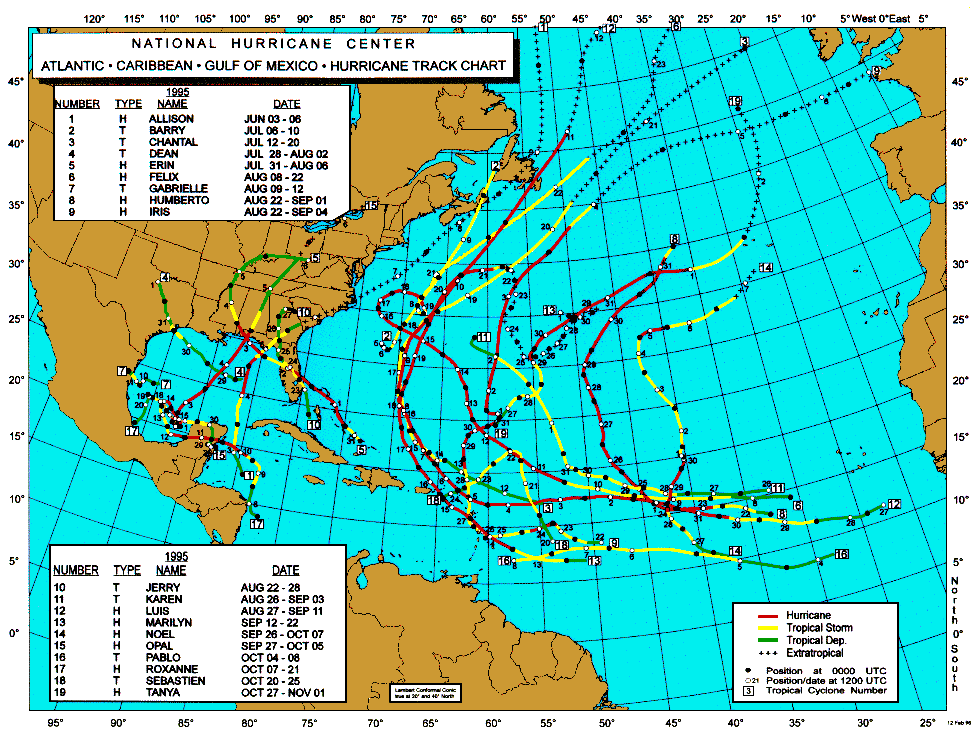
A more recent storm (and last under the mentionable category) was fairly impressive as it wound its way north out of the Gulf of Mexico, through Alabama, Tennessee, Kentucky and into Northern Ohio. She was known as Hurricane Opal and had a 10-day life span from September 27th to October 6th, 1995. On the evening of Oct 5th at 8pm, the remnants of Opal were located over the eastern Great Lakes. What was left of the "eye", or center of the storm, was well indicated on the NWS Doppler radar in White Lake (DTX). The radar showed the "eye" over Sandusky, Ohio moving north out over western Lake Erie. Light to moderate rain, with isolated areas of heavy rain, extended from Southeast Lower Michigan east across Southwest Ontario and Northeast Ohio. Spotty light rain first made an appearance in Southeast Lower Michigan earlier in the day, during the forenoon hours. During the afternoon, steadier rainfall developed with the heaviest rain (.54) falling between 5pm and 7pm. The rain ended just after midnight with a total of 1.41 inches falling from the storm. With the approach of the storm on the 5th, a generally north wind picked up and averaged over 15 mph with gusts up into the 30s (peak wind gust was 38 mph)

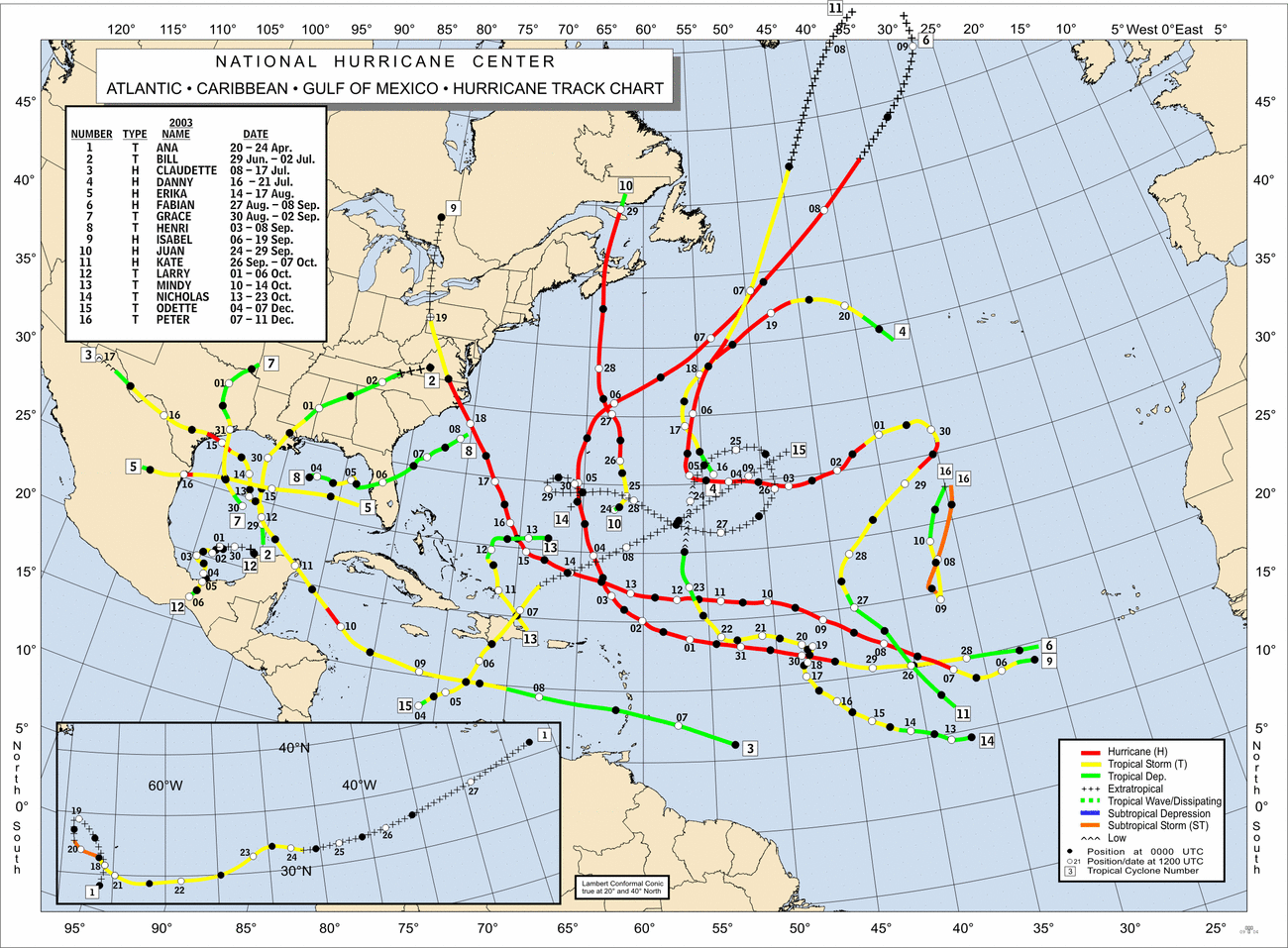
One of the more recent Hurricane remnants to affect the area was Isabel, which moved quickly through the Eastern Great Lakes on September 18-19th, 2003. Rainfall from the system was quite variable ranging from just a trace over far western areas of Southeast Michigan, to as much as 2 1/2 inches at local spots along the St. Clair River. In 2008, remnants of Hurricane Ike brought very heavy rains to the region along with strong winds and a brief F2 over western Wayne County.

The Astonishing Storm of September 25th, 1941

Earlier, I mentioned "one storm that screams for attention", but maybe "howls" would be more appropriate. Before researching this project, I expected to find the above case scenarios, but not the following...

  Recently /2013 changes/ the Hurricane Research Division /HRD/ did a reanalysis of the hurricane and its associated track and wind speeds. *Note the asterisks in the following storm account are adjusted for those changes. (Thanks to Hoosier, moderator of American Weather for the heads up on the reanalysis)
   
* The storm made landfall in Texas as a category 3

* After moving onshore and through its entire remaining path, the storm was upgraded by maintaining tropical force   
   winds as she evolved from a tropical storm to extra-tropical.. Also note the slightly westward track depicted over upper 
   Ohio Valley and Lower Great Lakes in Indiana and Michigan.

Comparing the two tracks;

    Original


     Reanalyzed


A tropical storm (#2 on original analysis map & #17-under 19-21, unseen on reanalyzed) formed in mid September over the Gulf of Mexico on September 17th, 1941. As it formed it meandered over the Gulf, making a loop in its track, well south of New Orleans. By this time it was a hurricane, intensifying briefly to a category #3 storm (111-130 mph wind) offshore as it took aim on eastern Texas. The hurricane made landfall late on the 23rd near Freeport, Texas with an estimated wind of a category #3* (111-130 mph), extremely high tides of nearly 11 feet and a barometer reading of 28.31 inches (959 MB). Further to the northeast, a ship just offshore of Texas City recorded a lowest pressure of 28.66 inches and winds of 83 mph. Other wind gusts were estimated near 100 mph at several locations near the hurricane's center along the Texas Gulf Coast. The hurricane quickly weakened to a category #1 (74-95 mph) as it made landfall and by the time the storm pushed on north to Houston, wind gusts had already dropped to 75 mph. Four lives were lost from the storm in Texas and property damage was estimated at $6.5 million (1941 dollars).

The storm continued to roar on its northward path through Texas and by 7 am on the 24th, it was located near the city of Tyler, over extreme northeast Texas. From this point on, the storm's last 36 hours or so really grabs ones interest for peculiarity as it tracked through the Mississippi Valley and on into the Great Lakes. From 7AM on the 24th to 7am the 25th, the storm shot northeast from Tyler to near Battle Creek, Michigan, covering close to 1000 miles in 24 hours! Thus, the forward movement of the remnants of the hurricane averaged 40 to 45 mph as it approached Southern Lower Michigan. As the storm tracked into the Great Lakes, it merged with a fairly strong cold front that pushed across the upper Midwest into the Lakes. The combination of the strong push of cool fall air, strong upper level dynamics and the remnants of the hurricane created quite a storm (not unlike the more common intense late fall cyclones that are seen in the Great Lakes). In addition, the track and speed of our "hurricane" brings to mind that of the "Panhandle Low" type of low pressure system in the winter (more information). While the speed of the system was fairly quick, it's not uncommon for hurricanes to accelerate northeast as they become extra-tropical and get "picked up" by the mid-latitude upper winds or jet stream. Yet, what was really unusual and noteworthy was the surface wind that accompanied the storm as it moved through the Great Lakes. By the time hurricanes make it this far north, they usually have blown themselves out, at least to the extent that surface winds are only gusting to, at best, 30 or 40 mph. Note the following, taken from the Detroit weather records on September 25th, 1941:

Windstorm: An intense tropical cyclone moving up from the Gulf thru eastern Texas (causing great damage in Texas), along the Missip. Valley and thence Newd across Ill & Mich, passing W & NW of Detroit with gale force winds and gusts to 65 mph from 10:18 AM - 2:30 PM & gusts to 75 mph 12:30 PM - 2:00 PM (see envelope back of book for newspaper clippings).

Most of the above noted news clippings show widespread wind damage to trees and power lines that would be commonplace in severe thunderstorms or a derecho. A derecho is a widespread windstorm consisting of a complex of thunderstorms that develop into a long-lived squall line. But there also were some unusual or freakish happenings (as the Detroit Free Press deemed them) as well. The following is taken September 26th, 1941, the day after, from the Detroit Free Press about the storm:

"River goes dry"

There were many freakish effects of the wind, including baring of the
Detroit River "middle grounds" off Belle Isle when water was backed into Lake St. Clair. The southwest gale literally blew the water out of The Detroit River, reducing its level by three feet, and leaving hundreds of pleasure craft high and dry on the muddy bottom. Several yachts broke their mooring or were heeled over at the Detroit Yacht Club. Another odd effect was the noticeable swaying of Downtown skyscrapers as the full force of the gale struck. Office employees who left tall downtown skyscrapers, were later reassured by engineers.

The Free Press goes on to say that "shortly after noon, the wind blew steadily at 56 miles an hour, but a times gusts reached hurricane velocity of 75 miles an hour." Dozens of people were injured by falling glass from windows blown out or debris tossed by the wind. One woman was literally blown into a fire hydrant, suffering a possible skull fracture. Other reports of scattered damage to homes and businesses across the region were mentioned in the article. In addition, the fierce wind churned up giant waves on the Lakes, including Lake Huron into the St. Clair River where two barges were blown ashore from of the shipping channel, even after dropping their heaviest anchors. In Southeast Lower Michigan, Storm Warnings were posted on Lakes Huron, Erie and St Clair at 10:30, the morning of the 25th. Downed telephone lines caused a disruption of service and communication across the Great Lakes and elsewhere. The "dying" hurricane left a trail of damage from Texas clear up into the Great Lakes and Canada. The wind of the storm was equated to an intense fall low pressure system that hit the area on November 29th, 1919 in which the wind blew 67 mph in Detroit and to the "Black Friday" storm in November of 1913.

The fact that the hurricane, after weakening and becoming extratropical, traveled over a thousand miles and still was able to maintain that much wind is extraordinary in itself. As the storm moved into Southern Lower Michigan, its center tracked northeast across Battle Creek, Lansing, Saginaw and then out over Lake Huron and into Ontario. Judging by the lowest pressure readings at Detroit (29.25 inches) and Flint (29.17 inches), where the wind gusted to 69 mph, its central pressure was estimated to around 29.10 inches (about 985 MB). Quite impressive for the remnants of a "dying" hurricane in the Great Lakes in September. In fact, this is the second lowest pressure reading ever recorded in Detroit during the month of September (the first being 29.21 inches on Sep 29th, 1966, during the passage of an intense early fall low pressure system).

One can only make a random guess as to the chances of another hurricane-force wind storm, from remnants of an actual hurricane, hitting the Great Lakes again. Since it was the only one of its kind in the record books at Detroit since records began in 1870, it may take several 100 years before another similar storm affects the region!

Hurroncane

One final, extremely interesting "hurricane" that affected the Great Lakes must be mentioned to make this article complete. While this storm was not from remnants of a tropical system, its development over Lake Huron had many uncanny likenesses to tropical systems...

The first likeness was its timing, forming over the Great Lakes right at the height of the typical hurricane season, September 11-15th, 1996. What started as a typical core-cold 500 MB low pressure system evolved into a warm-core system as it settled over the relatively warm waters of the Great Lakes, in particular, Lake Huron. The low pressure system actually had moved past Lake Huron but then retrograded, or was "drawn back", to the relatively warm waters of Lake Huron. (Similar to the tropics, the Great Lakes usually reach their warmest water temperatures late August into mid September.) The storm then deepened and intensified at the lower levels of the atmosphere compared to aloft, typical of a warm-core low. It is believed that the warm waters of Lake Huron and associated low level instability over the lake were, to a large extent, the major contributing factors in this storm's evolution. The storm went on to form a broad cyclonic circulation, including the "spiral bands and eye", typically seen in hurricanes! At one point, the cyclone produced tropical storm force winds (39 - 73 mph) and some of the spiral bands even had rainfall exceeding 10 cm (better than four inches), causing some flooding.

On satellite, the storm looked very much like the classic hurricane picture:


This "Hurroncane" reached its maximum intensity during the day on September 14th, when a central pressure of 29.34 inches (993 MB) was recorded in the late morning by a Lake Huron buoy that fortunately was positioned, at one point, in the "eye". By 2 PM, that "eye" measured close to 20 miles across and had a ring of tall convective clouds surrounding it, strongly resembling that of an "eye wall". The convective showers encircled the "eye" well out over 300 miles. As the "eye" moved to the southwest (retrograded), over the aforementioned buoy, the surface wind backed from west at close to 35 mph to the southeast, and then diminished to near 10 mph. After, the "eye" continued to track to the southwest, away from the buoy, and the surface wind backed further to the northeast, and briefly attained tropical storm force. A similar scenario but with varying wind speeds, would also be expected at the ocean's surface if a tropical system retrograded from northeast to the southwest overhead. In addition, the air temperature rose from 13°C (55°F) in the spiral shower bands, to near 18°C (64°F), which was also the lake temperature, in the clearing above the "eye". The storm weakened overnight as the lake temperature dropped 5°C (9°F). The lower water temperature helped greatly in weakening the storm as a result of the lower latent heat supply.

For additional information on hurricanes, check in with the
National Hurricane Center.

Background on "Hurroncane" was provided by a paper entitled "Hurricane Huron" by Mr. Todd Miner of Pennsylvania State University along with Dr. Peter Sousounis, Dr. Greg Mann and Mr. James Wallman of the University of Michigan.


Making weather fun while we all learn,
Bill Deedler - SEMI_WeatherHistorian


Sep 9, 2013

JUST WHAT IS INDIAN SUMMER AND DID INDIANS REALLY HAVE ANYTHING TO DO WITH IT?

JUST WHAT IS INDIAN SUMMER AND DID INDIANS REALLY HAVE ANYTHING TO DO WITH IT?

Written by: William R. Deedler, Weather Historian
(originally written in the Autumn of 1996)

An early American writer described Indian Summer well when he wrote, "The air is perfectly quiescent and all is stillness, as if Nature, after her exertions during the Summer, were now at rest." This passage belongs to the writer John Bradbury and was written nearly an "eternity" ago, back in 1817. But this passage is as relevant today as it was way back then. The term "Indian Summer" dates back to the 18th century in the United States. It can be defined as "any spell of warm, quiet, hazy weather that may occur in October or even early November." Basically, autumn is a transition season as the thunderstorms and severe weather of the summer give way to a tamer, calmer weather period before the turbulence of the winter commences.

The term "Indian Summer" is generally associated with a period of considerably above normal temperatures, accompanied by dry and hazy conditions ushered in on a south or southwesterly breeze. Several references make note of the fact that a true Indian Summer can not occur until there has been a killing frost/freeze. Since frost and freezing temperatures generally work their way south through the fall, this would give credence to the possibility of several Indian Summers occurring in a fall, especially across the northern areas where frost/freezes usually come early.

While almost exclusively thought of as an autumnal event, I was surprised to read that Indian Summers have been given credit for warm spells as late as December and January (but then, just where does that leave the "January Thaw" phenomenon?). Another topic of debate about Indian Summer has been "location, location". Evidently, some writers have made reference to it as native only to New England, while others have stated it happens over most of the United States, even along the Pacific coast. Probably the most common or accepted view on location for an Indian Summer would be from the Mid-Atlantic states north into New England, and then west across the Ohio Valley, Great Lakes, Midwest and Great Plains States. In other words, locations that generally have a winter on the horizon! But then, what about the king of winter weather in the United States, Alaska? Do they have an "Indian Summer", or something similar? Some places in Alaska are lucky to have a "summer", let alone an Indian Summer! One would certainly have to throw out the notion of it usually happening in October or November, when, winter generally has already taken an aggressive foothold on much of the state. What about other locations that come to mind, The Rocky Mountain States and parts of Canada, particularity in the east and south? Note: If anyone reading this has any information on Indian Summers in those areas questioned, or just thoughts on Indian Summers drop me a note or comment. (Editors note: Over the years while at the NWS, I received several fascinating notes from all over the world on how common and widespread "Indian Summers" were with each having it's own specific local or regional definition).

A typical weather map that reflects Indian Summer weather involves a large area of high pressure along or just off the East Coast. Occasionally, it will be this same high pressure that produced the frost/freeze conditions only a few nights before, as it moved out of Canada across the Plains, Midwest and Great Lakes and then finally, to the East Coast. Much warmer temperatures, from the deep South and Southwest, are then pulled north on southerly breezes resulting from the clockwise rotation of wind around the high pressure. It is characteristic for these conditions to last for at least a few days to well over a week and there may be several cases before winter sets in. Such a mild spell is usually broken when a strong low pressure system and attending cold front pushes across the region. This dramatic change results from a sharp shift in the upper winds or "jet stream" from the south or southwest to northwest or north. Of course, there can be some modifications to the above weather map scenario, but for simplicity and common occurrence sake, this is the general weather map.

Now we come to the origin of the term itself, "Indian Summer". Over the years, there has been a considerable amount of interest given to this topic in literature. Probably one of the most intensive studies occurred way back around the turn of the century. A paper by Albert Matthews, written in 1902, made an exhaustive study of the historical usage of the term. Evidently, the credit for the first usage of the term was mistakenly given to a man by the name of Major Ebenezer Denny, who used it in his "Journal", dated October 13th, 1794. The journal was kept at a town called Le Boeuf, which was near the present day city of Erie, Pennsylvania. Matthews however, uncovered an earlier usage of the term in 1778 by a frenchman called St. John de Crevecoeur. It appeared in a letter Crevecoeur wrote dated "German-flats, 17 Janvier, 1778." The following is a translation of a portion of the letter:
"Sometimes the rain is followed by an interval of calm and warmth which is called the Indian Summer; its characteristics are a tranquil atmosphere and general smokiness. Up to this epoch the approaches of winter are doubtful; it arrives about the middle of November, although snows and brief freezes often occur long before that date."
Since the writer says, "it is called the Indian Summer", obviously one could argue that term would have had to been used before him and became popular, but by whom, an earlier explorer or possibly an Indian tribe?

Now, after looking at all of this, the question you might ask yourself is, "Does the term 'Indian Summer' really have anything to do with Indians?" Again, there is host of possibilities, read on...

One explanation of the term "Indian Summer" might be that the early native Indians chose that time of year as their hunting season. This seems reasonable seeing the fall months are still considered the main hunting season for several animals. Also, the mild and hazy weather encourages the animals out, and the haziness of the air gives the hunter the advantage to sneak up on its prey without being detected. Taking this idea one step further, Indians at that time were known to have set fires to prairie grass, underbrush and woods to accentuate the hazy, smokey conditions. But Albert Matthews pointed out that the Indians also did this at other times of the year. Other possibilities include; the Indians made use of the dry, hazy weather to attack the whites before the hard winter set in; that this was the season of the Indian harvest; or, that the predominant southwest winds that accompanied the Indian Summer period were regarded by the Indians as a favor or "blessing" from a "god" in the desert Southwest. Another idea, of a more prejudicial origin, was that possibly the earliest English immigrants equated Indian Summer to "fools" Summer, given the reliability of the resulting weather. Finally, another hypothesis, not at all in the American Indian "camp" of theories, was put forward by an author by the name of H. E. Ware, who noted that ships at that time traversing the Indian Ocean loaded up their cargo the most during the "Indian Summer", or fair weather season. Several ships actually had an "I.S." on their hull at the load level thought safe during the Indian Summer.

In any event, there are several theories or possibilities of the explanation and origin of the term "Indian Summer", yet no one theory has actually been proven. Given the fact it has been centuries since the term first appeared, it will probably rest with its originators. All in all, even with the variety of opinions on this weather (or seasonal) phenomenon, the most popular belief of Indian Summer is as follows...It is an abnormally warm and dry weather period, varying in length, that comes in the autumn time of the year, usually in October or November, and only after the first killing frost/freeze. There may be several occurrences of Indian Summer in a fall season or none at all.

Since Indian Summers are fairly common, it would be interesting to find out if there is any correlation between the years that had no Indian Summer (in a particular area) and the type of winter weather that followed. Oh well, possibly another time and another article but enjoy the Indian Summer while its around, because one thing is for certain, it never lasts!

Making weather fun while we all learn,
Bill Deedler -SEMI_WeatherHistorian