4/10/13

The Battles Of Spring Are In The Air!

Finally some spring-like thunderstorms pulsed through Southeast Lower Michigan this second week of April. Along with the storms; very heavy rains soaked the mainly dormant landscape. Just a hint of green has been activated by the spring rains thus far, and mainly just grassy areas at that. Late you say? It's almost laughable when think back to last year at this time when our spring green-up was already over a month old. But last year of course was the truest of anomalies; the warmest March and early spring on record. Also while you're thinking back, you might remember, April settled down back closer to normal and averaged cooler than March! Extraordinary indeed! In addition, you might also remember the cold air masses in April that brought the killing frosts and freezes and heavily damaged the fruit crops. Well hopefully, we'll have none of that this year as we slowly warm and the growth appears, somewhat more gradual. After all, which is better; exhaust the cold air now or wait till the buds/flowers are on the fruit trees and spring growth is in full term?

But what of this spring? What spring you may ask? Oh it's there but you have to look closer for it. It's a whole different kind of spring...the inverse of last year...closer to our "normal spring" but thus far, it has indeed been colder and later. While March ended up 2 to 2 1/2 degrees below normal; April thus far has been worse! During the first third of the month /10 days/, temperatures have averaged as much as 3 to nearly 5 degrees below normal with the biggest departures up around the Saginaw Valley and Thumb District. Yes, when mother nature pays back; she can be a....   


The Great Lakes continue their icy chill as domes of cold, residual Siberian and Arctic air surge down, nearly unabated across the northern and even central states at times. This Arctic air continues to be funneled down across the Lakes; accentuating the typically early spring icy waters of the Great Lakes. And, as you can see by the widespread 30s to around 40 degree water temperatures as we approach mid April; the Great Lakes at this time of year do absolutely nothing in aiding our spring warm-up.

 
Arguably; no other weather map displays the spring air mass battle more appropriately than our present surface map for 8pm this evening; Wed Apr 10th. The battle line is clearly drawn, seen and heard by way of strong thunderstorms and very heavy rains along the quasi-stationary front draped west to east across the Lower Lakes/Upper Ohio Valley. Cold, residual Arctic air continues to be funneled down across the Great Lakes while at the same time, spring's warm southerly winds in response to an increasingly stronger spring sun, push northward up through the deep south and into the Ohio Valley! The resultant, strong baro-clinic zone also denoted by the sharp east/west temperature contrast across the region is exceptional; 30s and 40s to the north and 50s, 60s and 70s around and immediately to the south...all in a very tight area of landscape. 


The clash of the seasonal air masses; winter to the north and spring to the south indeed is in the air and will be for the next few weeks anyway as the cold, winter-like air masses slowly warm and moderate as they clash with springtime warmth. Our extended maps indicate this with a rather busy weather period for the next 10 to 14 days. I'll be on watch for more notable Mother Nature rou's or tantrums in the meantime.

Making weather fun while we all learn,
Bill Deedler -SEMI_WeatherHistorian

4/8/13

"January through March"; The Real Winter of 2012-13

Without a doubt, the Winter of 2012-13 was late in getting started and even statistically,  better suited the months of January through March rather than the standard climate months of December through February. In fact, March's average temperatures at all three climatological sites ended up colder than December's temperatures, something not seen often. Normals for Southeast Lower Michigan in December average in the upper 20s to around 30; while normals for March average in the mid 30s. Last December saw temperatures average in the mid 30s across the entire region (DTW - 35.9; FNT - 33.5; MBS - 34.1 for a Southeast Lower Michigan average of 34.5) which as you can see, match March's normals of mid 30s well.

In the reverse, this past March of 2013 saw temperatures average in the lower to mid 30s (DTW - 34.6; FNT - 32.2; MBS - 31.3 for an average of 32.7) nearly two degrees below December 2012's average temperature for Southeast Lower Michigan of 34.5! Not quite as cold as December's normal temperatures but still represented December better than December's 2012 actual temperatures did.

While normally March gradually warms up as the month unfolds, this really didn't happen until the last six days of the month when readings averaged normal to above. Two thirds of the month average below normal with the largest departures ironically coming when spring was to commence; the 20th and 21st with temperatures averaging 13.5 degrees below normal.  On the flip side to this cold, just two exceptionally mild days stole about a degree below monthly departure (in other words; the departure for the month would have been 3.0 - 3.5 degrees below normal, rather than 2.0 - 2.5 below). A storm center that pushed north of the region on the 10th/11th and pulled unseasonably mild air into the area with temperatures rising into the mid 50s to mid 60s...averaging 14 degrees above normal.

While snowfall around the region is still possible; chances diminish quite notably from early April to late April. And; despite the mild winter, snowfalls up through the first week of April actually performed admirably. Detroit has recorded 47.6" exactly +6.0" /norm- 41.6" thus far/ above normal and right on the normal-above normal threshold used in analogues. Normal snowfall for the entire season at Detroit; 42.7". Snowfall at Flint was a few inches below the normal thus far with 43.6" recorded, normal for the entire season stands at 47.4" and thus, -3.8" thus far.  Saginaw recorded 43.4" (just .2" different from Flint) and season normal stands at 46.1".

CLIMATOLOGICAL WINTER 2012-2013 (DEC, JAN, FEB) STATS/RANKINGS - NWS
 
---------------------------------------------------------------------

PRECIPITATION

              ACTUAL   NORMAL  DEPARTURE     RANKING
DETROIT AREA   8.92"    6.44"   +2.48"     11TH WETTEST
FLINT AREA     8.04"    5.03"   +3.01"      6TH WETTEST
SAGINAW        7.14"    5.24"   +1.90"     16TH WETTEST


AVERAGE TEMPERATURE

              ACTUAL   NORMAL  DEPARTURE     RANKING
DETROIT AREA   30.4     27.9     +2.5      17TH WARMEST
FLINT AREA     28.5     24.9     +3.6      10TH WARMEST
SAGINAW        28.5     24.7     +3.8      10TH WARMEST


AVERAGE HIGH TEMPERATURE! 
              ACTUAL   NORMAL  DEPARTURE     RANKING
DETROIT AREA   37.5     34.4     +3.1    T-16TH WARMEST
FLINT AREA     36.2     32.2     +4.0     T-8TH WARMEST
SAGINAW        35.2     31.4     +3.8          N/A*


AVERAGE LOW TEMPERATURE

              ACTUAL   NORMAL  DEPARTURE     RANKING
DETROIT AREA   24.0     21.4     +2.6      21ST WARMEST
FLINT AREA     20.9     17.7     +3.2      14TH WARMEST
SAGINAW        21.7     18.0     +3.7          N/A*


DETROIT AREA HAS A CLIMATE RECORD DATING TO NOVEMBER 1874
FLINT AREA HAS A CLIMATE RECORD DATING TO JANUARY 1921
SAGINAW HAS A CLIMATE RECORD DATING TO JANUARY 1912

*RANKINGS OUTSIDE THE TOP 20 FOR SAGINAW ARE CURRENTLY UNAVAILABLE
DUE TO ONGOING UPDATES FOR THE SAGINAW AREA DATABASE
_______________________________________________________________
 
 
Next up on the Winter of 2012-13; I'll take a look at the analogue 
performance and what analogue(s) performed the best in relevance to
this winter and associated spring projections.
 
Making weather fun while we all learn,
Bill Deedler -SEMI_WeatherHistorian


3/27/13

Easter to Close Cold March With a New Polar Blast On Our Doorstep; But Before Then...

Below average temperatures have dominated this March across Southeast Lower Michigan (and much of the region east of Rockies for that matter) but this Easter weekend (the last few days of March) will go out closer to normal...but it won't last! Mother Nature should give inhabitants of Southeast Lower Michigan a bit of a reprieve this Easter weekend with closer to normal temperatures with highs around 50 to possibly even mid 50s with enough sunshine both Holy Saturday and Easter Sunday.

Look for temperatures for Easter services to be in the 40s and again; lower to mid 50s for highs on Easter before before the gates come crashing down by Monday; appropriately named April Fool's Day. And, anyone who believed winter left for good will be made a fool of by Mom Nature on Monday and Tuesday as temperatures plunge back down into 30s to around 40. Again; well below the normal of lower to mid 50s by the turn of the month. And, with the opening Tiger's game in Minneapolis (or had it been Detroit, for that matter) on April Fool's Day, you KNOW you're just asking for trouble; what were they thinking?


Unfortunately Easter won't be completely unmarred; there will be a chance of showers with the next wave of colder air and snow showers on April Fool's Day.

So why has there been such a slow start to spring? I discussed some of that in my last few blogs; Spring Outlook and Negative Arctic Oscillation. Things are beginning to look up as we enter the second month of spring and we'll take a look at the rest of spring including a rather decent analogue year thus far this past winter and early spring, next week.

Have a good Easter!
Making weather fun while we all learn,
Bill Deedler -SEMI_WeatherHistorian

3/19/13

Extremely Negative Arctic Oscillation Draining Arctic Air Into The Great Lakes and East Upon Spring's Fanfare


Earlier in my Spring Outlook I wrote the reasons why I expected much of March to be colder than average. I see absolutely no reason to adjust that prediction (though some moderation is possible by the weekend) as a strong blocking pattern in the upper wind pattern continues to hold sway over the Eastern North American continent. This blocking pattern in conjunction (and mainly the result of) with an an extremity negative Arctic Oscillation /AO/. Word from the Weather Prediction Center /WPC/ today confirms that with following discussion;

NWS WEATHER PREDICTION CENTER COLLEGE PARK MD
1102 AM EDT TUE MAR 19 2013

VALID 12Z FRI MAR 22 2013 - 12Z TUE MAR 26 2013

MULTI-DAY MODEL AVERAGES DEPICT A SPLIT FLOW OVER NORTH AMERICA AT
THE MEDIUM RANGE, WITH CONTINENTAL POLAR AND ARCTIC AIR FEEDING
INTO THE CENTRAL AND EASTERN STATES, AND A PACIFIC JET DIVING
THROUGH THE WEST AND ACROSS THE DEEP SOUTH. THE EXTREME AMPLITUDE
AND PERSISTENCE OF THE NORTHERN STREAM OWES TO THE NEAR-RECORD
NEGATIVE ARCTIC OSCILLATION--EXPECTED TO BOTTOM OUT AT THE SHORT
RANGE. 
 
  Note the latest projection of the AO for the rest of March. The extremely negative AO is projected this week, ironically bottoming-out right around the first day of spring!

 
What do I mean by "strong blocking pattern" in the upper wind pattern? See Map -1

                                                                                                                Map -1

First Day of Spring? More Like the First Day of Winter! 

On March 20, 2013, at precisely 7:02 A.M. EDT, the Sun will cross directly over the Earth's equator. This moment is known as the vernal equinox in the Northern Hemisphere.

Ironically; the following projection /Map -2/ of the upper air pattern /5,000 ft/ Thursday morning the first full day /24 hrs/ of spring across North America in the east is a pitiful rendition of a spring time weather map. Actually, if one were to look at it and asked; what first calendar day of a season does this look like? "Winter" would be pretty much the unanimous reply! Note; I highlighted the -15c /+5f/ air pockets at 5,000 ft...one where it should be over the polar region and the other where it shouldn't...over the Great Lakes and Southeast Lower Michigan /black dot/. Note; the freezing line 0c /32f/ extends far south into the Southeast Gulf states. 

Temperatures across Southeast Lower Michigan are/will be more typical mid January through the remainder of the week with again; some moderation due this weekend. With that moderation; latest models are intimating another storm system to form over the mid Mississippi Valley with its sights set on the Ohio Valley and possibly the southern Lakes region early next week. We also know the errors of the models lately have been in this area; so prudence will prevail at this time. ;-)

                                                                                                           Map - 2
 
 
Making weather fun while we all learn,
Bill Deedler -SEMI_WeatherHistorian

3/17/13

MILD MARCH MADNESS - 1945

I wrote this article BEFORE last March's record warmth. Still,
it is a very interesting account of that March of 1945...and 
also, the spring that followed it! Ironically, a similar wide-
spread severe crop damage occurred back in April of 1945 like 
last April's; due to cold and frosts. And, that was only a
portion of that spring's (not to mention the previous winter's)
weather issues! Enjoy... 
 
                 MILD MARCH MADNESS - 1945   

When looking through the month of March records in Southeast
Lower Michigan, one can't help but notice March 1945. The
temperature departure alone is awesome. March of 1945 made 
the record books as the warmest March ever, before and since 
(1870-1996) in Detroit. The average temperature of 47.9 (all
right, let's cheat and say 48 degrees) is extraordinary in 
itself when considering the current normal, or average,
temperature in Detroit for March is 35.7 degrees. In 1945
however, the normal was even lower at 33.0 degrees (normals 
for Detroit have been rising through the years). March of 
1945's average or mean temperature not only surpassed the 
current March's normal temperature by more than 12 degrees
(+12.2), the 1945 normal by nearly 15 degrees (+14.9) but
even bettered the current April's normal by about a half
degree (normal mean for April in Detroit is 47.3).

Well, you might ask "Did this LAMB of a month start out and 
end that way?" Yes, right from the start there were no LIONS
to be seen this March. During the first few days of the month,
temperatures averaged about 10 degrees above normal, while 
near the end of the month, readings averaged 15 to as much as
30 degrees above normal(see Table-1). Other temperature facts
during the month which are just as outstanding are: only one 
day during the month averaged below normal and that was only 
by 2 degrees, over half the month's (17 days) high temperatures
were 60 or better with nine of those days rising to 70 or better
and one even climbing above the 80-degree mark (82)! Keep in
mind, the current normal high for March is only 44.4 degrees.

As one might expect, with all the warm weather there would 
be some record high temperatures established and there were... 
six (Table-1). It's also interesting to note that the highest
mean temperature during the month, 68 degrees on the 28th, is
normal for the first day of summer, while the high that day of
82 is about normal for the 4th of July!

Abundant sunshine during the month (66% vs the normal of 51%)
certainly aided strongly in establishing this record warm month.
Even though sunshine was above normal for the month, rainfall 
was also, with three and a half inches falling. With above 
normal heat and rainfall during the month, one might also think
that it would be an active thunderstorm/severe weather month.
The observations at Detroit indicate otherwise, with only two
days having thunderstorms. The thunderstorm activity remained
heavily concentrated to the south in the Ohio Valley.

Speaking of the weather pattern, lets take a look at the general
weather pattern that created such an unseasonably warm month.
Needless to say, with such a warm March, all the real Arctic
cold remained bottled up in Canada. This was due to a strong
west-southwesterly flow across the U.S. from the Pacific. This
strong predominant flow of mild maritime air kept any Arctic 
cold high pressure areas well north of the region. The high
pressure areas that did move across the area were of Pacific
origin and thus, contained milder air. 

The strong west southwesterly jet stream across the country
also kept an active storm track in place, but it was mainly 
west and south of Southeast Lower Michigan. Several low 
pressure areas and attending frontal systems moved east
northeast across the Ohio River region and dumped copious 
amounts of rain, creating severe flooding in that area (not
unlike the early March storm track pattern of this year). 
Rainfall amounts of eight to 14 inches in March were common 
from the Arkansas area northeast across Kentucky and Ohio 
into Pennsylvania. In fact, at least up until that time, 
March of 1945 was the wettest month ever in Ohio. The low
pressure systems that moved west of Southeast Lower Michigan,
pulled very warm (for March) air north from the deep South
into the Great Lakes States.

The strong west-southwesterly flow over the country developed
a weak, but fairly persistent, ridge of high pressure over the 
eastern third of the country. Therefore, for you meteorological
buffs, the 500 MB heights averaged above normal (540-542 meters
over the southern Great Lakes). At the 850 MB level (5,000 ft),
the average 0'C isotherm (32'f) was well north of Southeast 
Lower Michigan, lying east-west across the tip of Northern 
Lower Michigan.      

In the end, it seems like Mother Nature always manages to
balance things out, as was the case this time. One can't
help but wonder if the people of the time felt a "payback"
was in the works for such a early, warm Spring. The Winter
and Spring of 1945 certainly brought their share of weather
extremes across the Great Lakes and Ohio Valley. 

In addition to the warm March and severe flooding in the Ohio
Valley, the following was obtained from the "Monthly Weather
Review" Publication:


     The year 1945 was notable for the severe cold
     weather, record snowfall, and continuous snow 
     cover in the eastern portion of the country until
     February; an abnormally warm March east of the
     Rockies; and unfavorably cool, wet weather for much
     of the remainder of the year- especially April, May
     and June- in the central and northeastern sections. 
     
     
     Abnormal warmth prevailed during March over
     practically the entire region east of the Rocky
     Mountains. Temperatures averaged higher than for any
     previous March on record for the States of Indiana,
     Ohio, Michigan, New York, New England, New Jersey,
     North and South Carolina. The month was extremely
     wet in central parts of the country, especially the
     Ohio and Mississippi Valleys, where disastrous
     floods occurred. Unusual warmth and generally
     adequate moisture caused vegetation to advance
     rapidly over practically the entire region east of
     the Rockies and by the end of March, the season was
     from 2 weeks to a month ahead of normal.
     
     The possibility of dangerous freezing, with
     vegetation, especially fruit, at such a critical
     stage of development so early in the season, became
     a reality when from April 4-7 and on the 23rd cold
     weather overspread central and eastern sections of
     the county and brought severe frosts and freezing
     southward as far as Oklahoma, Arkansas, the Ohio
     Valley and many southern Appalachian regions, with
     considerable damage to fruit and early gardens.
     
     Continued wet weather from Oklahoma and Arkansas 
     to the Great Lakes, seriously delayed seeding and
     development of crops, notably corn. One of the 
     worst April snowstorms of record occurred in Iowa
     and some adjacent states on the 3rd and 4th. May 
     was unfavorably cool...especially in the northern
     interior, with frosts in sections of the southern
     Lakes Region as late as the 24th and 30th. An
     unusual May snowstorm moved across the more northern
     states with falls up to 8 inches in Iowa on the 9th,
     and 10 inches to 2 feet in New England on the 10th
     and 11th.
     
And there were the usual severe events and tornadoes but still,
a quite eventful and somewhat extraordinary Spring indeed! 

By the way, What was the second warmest March on record in
Detroit you might ask?  Believe or not...the next year, 1946!


-----------------------------------------------------------------
TABLE - 1           DETROIT MI -  MARCH 1945
-----------------------------------------------------------------
DATE   MAX  MIN  MEAN  DEPART      DATE   MAX  MIN  MEAN  DEPART
_________________________________________________________________
3/01   44   23    34    + 6        3/17 # 75   44    60    +27 
3/02   42   38    40    +12        3/18   63   41    52    +18
3/03   53   29    41    +13        3/19   70   49    60    +26
3/04   40   25    32    + 4        3/20   61   37    49    +15
3/05   63   32    48    +19        3/21   45   35    40    + 5
3/06   53   27    40    +11 >(.3)  3/22   54   31    42    + 7
3/07   36   21    28 ** - 2        3/23 # 73   40    56    +20
3/08   39   24    32    + 2        3/24   63   39    51    +15
3/09   45   27    36    + 6        3/25 # 78   43    60    +24
3/10   38   29    34    + 4        3/26   73   51    62    +25
3/11   45   25    35    + 4        3/27 # 79   53    66    +29
3/12   52   35    44    +13        3/28 #*82   55    68    +30
3/13   53   30    42    +10        3/29   65   44    54    +16
3/14   67   36    52    +20        3/30   62   42    52    +13
3/15   70   46    58    +26        3/31   60   45    52    +13
3/16 # 74   56    65    +32

> ONLY SNOWFALL RECORDED                                   
# RECORD HIGH (STILL STANDING, EXCEPT 3/23 TIED IN 1994)
* HIGHEST TEMPERATURE EVER RECORDED IN MARCH
**ONLY DAY BELOW NORMAL IN MARCH
  
 Average    Average              Normal        Departure
High Temp   Low Temp   Mean   (1945) (1997)  (1945)  (1997)
 
  58.6       37.2      47.9    33.0   35.7    +14.9  +12.2 

Making weather fun while we all learn,
Bill Deedler -SEMI_WeatherHistorian


3/12/13

Updated 3/13 - Winter Arrived Late This Year; Will Spring?

*Updated 3/13 to include Great Lakes water temperatures
 
Let cut right to the chase; meteorological winter made a liar out of me since I predicted normal to below normal temperatures in Southeast Lower Michigan for the Winter of 2012-13. Early on; most guidance suggested it and analogues backed it up, so what happened? Nothing...other than winter come late to the party and screwed up my temperature forecast ;-). As mentioned many times in my outlooks and discussions, timing is one of the biggest problems in forecasts... particularly monthly and seasonal. Many of the analogues had the pattern pegged (above normal temperatures early winter to below mid & late) but none were as mild as the Winter of 2012-13.

Averaged out; temperatures for the meteorological winter (December through February) came in above normal across Southeast Lower Michigan (scroll down to data from the NWS). In fact, December into mid January averaged well above. However, as the second half of the meteorological winter (mid January - February) evolved; the pattern I was looking for to dominate through much of the winter did in fact, materialize. And, with the exception of the "few day heat wave" at the close of the January; mid January on into early March really "began" winter with normal to below normal temperatures (dark blue temperature trace). In February, not only did temperatures average normal to below across Southeast Lower Michigan but much of the region got pestered (or treated depending on one's view) with frequent snows...making it also, a snowy month. It's really not so unusual for winter to not get a foothold on the region until around Christmas but mid January, mom nature has some explaining.

It is one thing to discuss the winter temperatures, another to actually visualize it...therefore, a picture is worth a thousand words...or at least a paragraph or two. ;-)


It's easy to see how temperatures (above the mean yellow normal line) for much of January averaged above normal. A change of the trend (temperatures below the mean yellow normal line) began when the first real cold snap of the winter pushed temperatures down to near zero during the 21st-23rd (5,-1,5 @ DTW and colder elsewhere). Quickly after; there was one more warm surge on the 29-30th (57, 62 @ DTW) only to come crashing back down to the single figures Feb 1st, 3rd (9, 5 @ DTW). Many of the meteorological inclined can visualize the amplified and progressive upper air pattern creating the temperature fluctuations at that time.

Ah well, if January through March had been our meteorological winter; maybe a hit instead of a miss? Many of my comrades share with me the difficulty in predicting this past winter season three months out and sometimes, the weather for just three days.  It seems all across the country mom nature kept weatherman on their toes (and sometimes, biting their nails ;-). But that's the past and on to the future....after a few statistics.


The following are the temperature and precipitation statistics for the three climate locations in Southeast Lower Michigan. Snowfall is not included since theoretically, it's not over for the winter.

                             Winter 2012-13 Statistics *

                AVERAGE TEMPERATURE

              ACTUAL   NORMAL  DEPARTURE     RANKING
DETROIT AREA   30.4     27.9     +2.5      17TH WARMEST
FLINT AREA     28.5     24.9     +3.6      10TH WARMEST
SAGINAW        28.5     24.7     +3.8      10TH WARMEST
 
                   AVERAGE HIGH TEMPERATURE

              ACTUAL   NORMAL  DEPARTURE     RANKING
DETROIT AREA   37.5     34.4     +3.1    T-16TH WARMEST
FLINT AREA     36.2     32.2     +4.0     T-8TH WARMEST
SAGINAW        35.2     31.4     +3.8          N/A 


                   AVERAGE LOW TEMPERATURE

              ACTUAL   NORMAL  DEPARTURE     RANKING
DETROIT AREA   24.0     21.4     +2.6      21ST WARMEST
FLINT AREA     20.9     17.7     +3.2      14TH WARMEST
SAGINAW        21.7     18.0     +3.7          N/A 


                       PRECIPITATION

              ACTUAL   NORMAL  DEPARTURE     RANKING
DETROIT AREA   8.92"    6.44"   +2.48"     11TH WETTEST
FLINT AREA     8.04"    5.03"   +3.01"      6TH WETTEST
SAGINAW        7.14"    5.24"   +1.90"     16TH WETTEST
 
* Data supplied from the National Weather Service White Lk. /DTX/
 
 
Spring 2013 Outlook

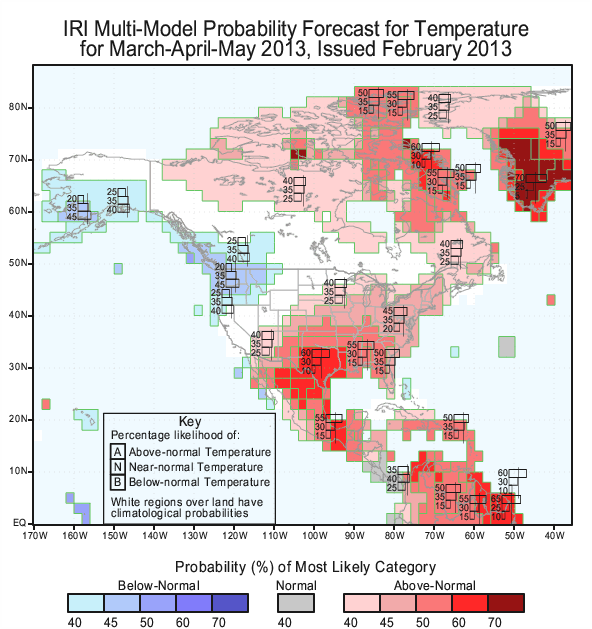
Since winter got a late start, does that automatically mean spring will too? Not necessarily, but in this case I think there will be likely some truth to that statement. However, that doesn't automatically mean that temperatures for spring on the whole, will average below normal. 

ENSO remains in a neutral pattern across the Pacific therefore, it will have little if any effect on our spring weather across Southeast Lower Michigan. The main players this spring will be the phase dominance of the NAO/AO, the PDO and PNA relating to the jet stream positioning and placements of long wave troughs and ridges.

Spring especially has that "curse" of being extremely changeable therefore, trends and pattern formations are even more fickle than winter. Being so changeable, projections for the season can be quite a challenge. I will discuss what prevailing temperatures and precipitation I expect along with reasoning. In future blogs, as in the past, I also plan to discuss notable changes and trends that will affect our spring weather .

Temperatures

I look for temperatures to average around normal to below during early spring as our late winter hangs over into much of March and possibly, even parts of April. That is not to say we won't have beautiful, warm spring days such as like Sunday (3/10) but overall temperatures early spring should still average around normal to below. For the latter half or so of spring on average, temperatures should have preference for above normal readings. All in all, I look for temperatures to average within 2 degrees of normal for the spring season.

Reasoning for the cooler than average early spring;
1 - Arctic Oscillation /AO/ recent preference for neutral to negative oscillation phase
Since mid winter our cyclical northern friend/foe has been oscillating between around average to below average and as one can see here, still shows a preference for that in the coming weeks. The second plot is an experimental projection of the Arctic Oscillation. Be advised; both these models change frequently and it is the prevailing trend we are concerned with when examining them.
Note both plots show an extreme negative Arctic Oscillation /as low as -4/ in the short term mid month. It will be interesting to see if this bears out.


2 -The more inclusive, North Atlantic Oscillation /NAO/ also shows a decided preference for a neutral to negatively phased oscillation.

3- The residual cold air stored over the Canadian/Polar regions which is aided by deep snow cover and relatively low sun angle early spring, acting like a freezer.

*4 - Great Lakes Water Temperatures /Added - 3/13/13 /

I wanted to also share the Great Lake's water and ice content as of 3/13/13 and adding to list of reasoning's for cool early spring. I was able to get the latest data from a the wonderful site /GLSEA/ which is part of the Great Lakes Environmental Research Lab /GLERL/. As you can see, several of the recent winter's water temperatures are on these charts. What I found interesting is the recent decrease in water temperatures so late this season, so much so, that now the water temperatures are really close to the colder winters we had in the recent past. In addition; note the big change (drop) from earlier this season for Lake's Michigan, Huron and Erie.


-Lake Michigan is colder than last year and 2010 and on par with 2011.
-Lake Huron is also colder than last year and 2010; and now very close to the remaining years.


-Most interesting of all is Lake Erie as it is the coldest now as it was in the coldest years. This would be due to it shallowness and our coldest part of the winter arriving late in the season.


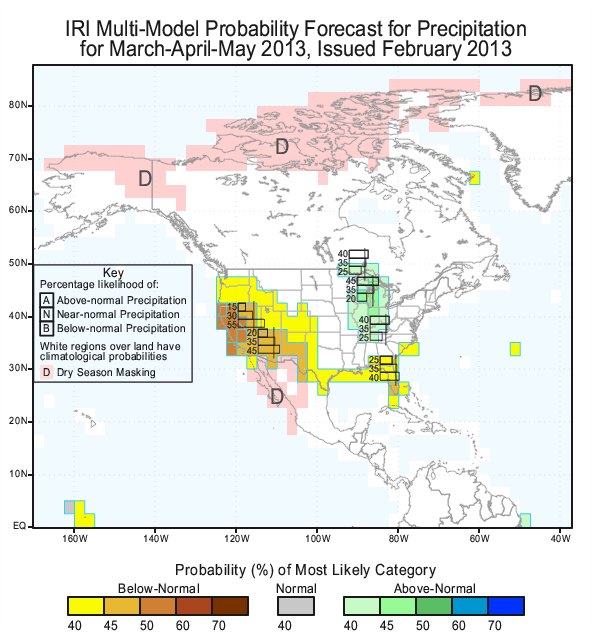
Some Model Temperature Projections for Spring:
(As you can see, just these three have somewhat differing opinions and sometimes Southeast Lower Michigan seems to be caught in the middle)


Precipitation/Severe Weather

Rainfall should average around normal to above across the region as confrontation zones set up along the fairly active spring pattern induced by a fluctuating NAO and semi-permanent ridge over the southeast part of the country. The interaction will induce normal to above normal rainfall. Generally, in this sort of pattern; severe weather would be expected to be active. This will greatly depend on how dominant a particular phase of the NAO is this spring along with attending jet cores and available instability per event. A strongly negative /NAO-/ would tend to hold the more active severe weather to our south, whereas a more variable NAO oscillation would tend to allow more warmth, instability and stormy periods. I'll keep a lookout for possible upcoming active severe weather episodes.

Model projections for precipitation


Making weather fun while we all learn,
Bill Deedler -SEMI_WeatherHistorian


3/7/13

Update; Interview slated to run Tonight, Thursday March 7th on the 7PM Newscast

I just received word from Ms Vogel the weather interview will run tonight, March 7th during the 7pm news in the weather segment. 


Thank You all for following my blog and as always, your thoughts and ideas on subject matter are always welcome.

Making weather fun while we all learn,
Bill Deedler -SEMI_WeatherHistorian


3/3/13

Update 3/5/13 - New Week; New Storm?

Update 3/5/13...
Looking at model, radar and satellite trends of the snow occurring to the west and south of the region as of noon; the storm will remain south of Southeast Lower Michigan. While there may be flurries or a dusting near the Ohio border, no appreciable accumulation is expected. So ends the chapter on the "storm that couldn't - in Southeast Lower Michigan".

Update 3/4/13...
Latest guidance has now reverted back to the original, further south track of the projected storm along with much of its significant snow. In the discussion yesterday; I mentioned the risk of this happening since the models earlier tracks were further south and the northward track, a recent development.

"there is still quite a variance of storm tracks possible with this system and it is possible Southeast Lower Michigan misses the brunt of the storm IF she forms or dives further southeast. This further southeast projection WAS the original track on this storm just a few days ago, so nothing is for certain but know this; the track has been lifting northward recently."

Though the original, further south track looked reasonable to me earlier, I decided I needed to give a heads up about the potential of the storm yesterday considering; 1- the recent northward shift of the action; especially relying on "better data" ingested into the models for the latest period and 2- the snow risk of rather significant snow amounts (several inches) over the far southern half of the region.

Consensus data from the latest Monday morning runs; shows not only having the further south track re-appearing but the latest cut-off line of snow and no snow remains unusually sharp, leaving much of Southeast Lower Michigan with no snow. Yesterday's thinking as far as where the risk of snow was - over the southern half of the region - therefore can be trimmed back further.

Snowfall is still possible over the far four southern counties of Southeast Lower Michigan... Washtenaw...Wayne...Lenawee and Monroe. The best snowfall of an inch or two would be over Lenawee and Monroe counties with up to around an inch in Washtenaw and Wayne. Respecting the sharp cut-off with the snowfall pattern; the northern portions of Washtenaw and Wayne should receive the least. Timing will be mainly overnight Tuesday into Wednesday morning.

This continues to be a very difficult forecast because any oscillation of 50 miles or so would be the difference of no snow and a few inches. Therefore; stay tuned, "cause the fun continues!"

Note; Meteorologist Hally Vogel from ABC's Channel -7 Detroit Action News team interviewed me recently on two of our biggest snowstorms in modern times to hit the Metro Detroit area and/or Southeast Lower Michigan. One storm being the Dec 1st, 1974 storm and the other; the Great Blizzard of January 1978. I worked both storms and relayed my experiences and subsequent outcomes of those two very memorable storms early in my career in these write-ups and interview. As of this time; the short piece is set to air Wednesday March 6th, during the 5 pm weather segment (around 515 PM) with other weather interview segments possible in the future. Any changes I will update.
_________________________________________________________________________________

Original Blog 3/4/13...
Over the past day or so, guidance has been coming together of a new storm brewing over the Northern Plains while another takes shape over the Texas Panhandle (map -1). Our guidance seems to want to "mate" or phase these storms over the Ohio Valley with time, by forming a signification storm  across the Ohio Valley in the vicinity of Indiana, Ohio and Kentucky (with the center of the combining lows near Cincinnati (map -2). How well developed she is at that time along with moisture and ultimate track will dictate the final outcome of the snow potential for Southeast Lower Michigan.

Of all the data coming in on this storm; perhaps the most consistent is timing and ironically thus far; it's almost a duplicate of last week's storm.  Consensus is for the storm to begin to affect Southeast Lower Michigan during the afternoon hours of Tuesday into Tuesday night and Wednesday morning. Sound familiar?

There is the potential for this storm to bring a significant amount of snow to at least portions of Southeast Lower Michigan and at this time the best chances appears to be the southern half of the region. If this were to bear out; the areas most affected would include the cities and surrounding communities of Ann Arbor into the suburbs of Detroit and the city of Detroit; southward to the Ohio border. Of course, this is all very preliminary and subject to change as sampling improves on this potential developing storm. Basically; the timing of the two systems along with their interaction will tell the story. The next few model runs should get a better handle on data. In addition; a sharp cut-off of the snowfall extent to the north was noted across Southeast Lower Michigan.

While the forecasted dynamics and moisture available for this storm has been improving with each model(s) runs; there is still quite a variance of storm tracks possible with this system and it is possible Southeast Lower Michigan misses the brunt of the storm IF she forms or dives further southeast. This further southeast projection WAS the original track on this storm just a few days ago, so nothing is for certain but know this; the track has been lifting northward recently. See the latest track below /GFS/ (note; the Euro was not in as of this post but all  referred to were the NAM, GFS, UKMET & GEM):


Stay Tuned for further updates on this rather recent development.

Making weather fun while we all learn,
Bill Deedler -SEMI_WeatherHistorian


2/26/13

Update 2/27/13 - Feb 26-27, 2013 Snow Totals

Epilogue;
Snowstorm Totals From the NWS DTX


Feb 26-27, 2013 Snow Totals

A strong low pressure system originating near Texas tracked northeast into the Ohio Valley. This storm induced blizzard, winter storm, and tornado headlines as it tracked through the US. As the low lifted north, a mix of rain, freezing rain, sleet, and snow commenced Tuesday afternoon. A changeover to snow began near 4-7pm for most areas. A general 3-5" swath of snow fell across most of Southeast Michigan. Text and graphic summaries are available below. Snowfall totals through 10 am February 27th, 2013, are available in graphic and text formats.


PUBLIC INFORMATION STATEMENT...STORM TOTALS
NATIONAL WEATHER SERVICE DETROIT/PONTIAC MI
1016 AM EST WED FEB 27 2013

 
STORM TOTAL SNOW REPORTS

LOCATION                  SNOWFALL     DURATION
                          (INCHES)      (HOURS)        LAT       LON

...BAY COUNTY...
   AUBURN                  M   2.6           12     43.60N    84.08W

...GENESEE COUNTY...
   BURTON                  M   2.2           14     43.00N    83.62W
   FLINT                   M   2.8           14     43.02N    83.69W
   LINDEN                  M   3.0           14     42.82N    83.78W

...HURON COUNTY...
   FILION                  M   0.6           12     43.90N    83.00W
   BAD AXE                 M   3.2           11     43.80N    83.00W

...LAPEER COUNTY...
   LAPEER                  M   4.2           14     43.05N    83.32W
   LUM                     M   5.1           15     43.10N    83.15W
   NORTH BRANCH            M   5.4           14     43.23N    83.19W

...LENAWEE COUNTY...
   ADRIAN                  M   3.0           12     41.90N    84.04W
   TIPTON                  M   6.0           14     42.02N    84.06W

...LIVINGSTON COUNTY...
   HOWELL                  M   2.0           13     42.61N    83.94W

...MACOMB COUNTY...
   STERLING HEIGHTS        M   3.0           13     42.58N    83.03W
   MOUNT CLEMENS           M   5.5            8     42.60N    82.88W

...MONROE COUNTY...
   MONROE                  M   0.8            M     41.92N    83.39W
   DUNDEE                  M   3.7           14     41.96N    83.66W

...OAKLAND COUNTY...
   HOLLY                   M   2.8           14     42.80N    83.62W
   2 N NOVI                M   4.0           12     42.50N    83.49W
   BLOOMFIELD HILLS        M   4.0           14     42.58N    83.25W
   CLARKSTON               M   4.0           14     42.74N    83.42W
   SOUTHFIELD              M   4.0           12     42.48N    83.26W
   FARMINGTON HILLS        M   4.3           14     42.49N    83.38W
   WHITE LAKE              M   4.5           14     42.65N    83.50W

...SAGINAW COUNTY...
   5 S MERRILL             M   4.0           13     43.34N    84.34W
   FREELAND                M   4.5           13     43.52N    84.12W
   HEMLOCK                 M   6.5           14     43.42N    84.23W

...SANILAC COUNTY...
   DECKERVILLE             M   5.0           12     43.53N    82.74W
   LEXINGTON               M   5.0           13     43.27N    82.53W
   SANDUSKY                M   5.0           13     43.42N    82.83W

...SHIAWASSEE COUNTY...
   CORUNNA                 M   3.0           12     42.98N    84.12W
   OWOSSO                  M   3.7           14     43.00N    84.18W

...ST. CLAIR COUNTY...
   YALE                    M   4.5           13     43.13N    82.80W

...TUSCOLA COUNTY...
   FAIRGROVE               M   2.0           12     43.52N    83.54W
   VASSAR                  M   2.6           14     43.37N    83.58W
   CARO                    M   3.0           12     43.49N    83.40W

...WASHTENAW COUNTY...
   SALINE                  M   3.6           14     42.18N    83.78W
   MANCHESTER              M   4.0           14     42.15N    84.04W
   5 SE ANN ARBOR          M   5.0           13     42.22N    83.66W
   CHELSEA                 M   5.0           14     42.31N    84.02W
   1 W ANN ARBOR           M   5.5           14     42.28N    83.75W
   DEXTER                  M   6.8           14     42.33N    83.88W
   1 S ANN ARBOR           M   7.0           14     42.26N    83.73W

...WAYNE COUNTY...
   GROSSE POINTE FARMS     M   2.4           14     42.40N    82.89W
   ROMULUS                 M   3.0           14     42.22N    83.37W


M = MEASURED
E = ESTIMATED


________________________________________________________________________________


Update 2/26/13...100 PM

Mixed precipitation will advance across Southeast Lower Michigan during the afternoon quicker than initially anticipated...therefore a longer period of rain...snow...sleet and freezing rain will occur into at least early evening. Because of more mixed precipitation; snowfall amounts will be impacted, especially over extreme Southeast Lower Michigan. Latest guidance /12z - 7AM/ continues to wrap in pockets of milder (above freezing air) into the storm into the evening anyway. This was the risk noted in earlier forecasts below and thus, snowfalls have been adjusted lower.

Snowfalls across extreme Southeast Lower Michigan from I-94 south to the Ohio border will be impacted the most with generally 1" - 3" likely. The remaining area of Southeast Lower Michigan;  Detroit, Detroit's northwest-northeast suburbs, Ann Arbor, Flint, Saginaw Valley and Port Huron amounts will vary from 2" - 3" over the extreme southern regions to 3" - 5" across the majority of the region into the northern areas. Best snowfalls will remain over the northeast counties including the Thumb where 4" - 6" is expected to accumulate. Stiff northeast winds will gradually shift to north at 15 to 25 mph with gusts around 30 mph into tonight before diminishing.

Update 2/25/13...

Snowfalls
Generally I look for a 4" - 7" total of heavy wet snow over much of region from this system through  Wednesday - with much of that snow falling late Tuesday into midday Wednesday. Eastern counties, especially downwind of Lake Huron may see highest with isolated 8" or so possible.  I will update if the system information changes going into the event.

Discussion
Overall very little has changed on our expected winter storm the past few days as most models continue to prog the storm in the track first outlined in the original blog 2/23. In fact; the major models are in remarkable agreement as to the general track of the low center with a subtle shift southward of both the 500H MB and surface low in the last 12-24 runs.

The European continues this lead (I originally chose in the initial blog below) with now both the GFS and the European pretty well in step. Of course; the devil is in the details...and in this case the problems lie in precipitation amounts and how much "warm air" gets entrained into the lower levels of the atmosphere. While this system somewhat resembles our Dec 26th storm it is much further north and thus; milder but at the same time the dynamics of the system are more impressive overhead as is its moisture feed from initially the Gulf and subsequently Atlantic.

The system has well developed features aloft including; a compact negative tilt structure that consolidates into a "bowling ball" shape that "hooks" for the Ohio pocket as she heads northeast. Meanwhile; the surface system along with the 700MB low follow along in good measure right into Southeast Lower Michigan and Northwest Ohio. And old rule of thumb with the 700 MB; to the left of center, generally the best snow can be expected in a mature system. And, while our storm is projected to weaken with time as she treks toward the Eastern Lakes; she still maintains a moderately impressive storm structure in our neck of the woods from Tuesday evening into the first half of Wednesday. In addition; right about the same time Atlantic moisture should rev-up into the system in conveyer-belt like fashion later in the aforementioned period. Good vertical velocity and energy aloft should make for a good dump of precipitation later Tuesday into Wednesday morning...though as with most systems this season, heaviest precipitation will be south and east of us...a noted trend this winter. Snowfall rates in spite of temperatures initially falling just into lower to mid 30s after precipitation onset may approach an inch an hour in the late afternoon to evening time frame in heavy wet snow. This timing may change if the precipitation advance slows a bit. A mixed bag of precipitation is also still in the cards, especially over extreme Southeast Lower Michigan and mainly in the initial stages of the event.
(see explanation below). A stiff and gusty northeast wind at 15 to 25 mph with gusts to around 30 mph will accompany the precipitation  into early Wednesday.

                                                500H with vorticity est maxima's (X)


Now; the above scenario is all nice and good but she (500 MB Jet) also gets the boot from energy diving into her back/west side which why may help with troughing westward; will also help move things along to the east. Therefore; the center of the best action doesn't stick around quite as long as I would like to see for the BIG accumulations.

Besides less precipitation than earlier expected; another problem is the system still nicks Southeast Lower Michigan enough so that pockets or envelops of "milder, above freezing" ice-crystal melting air will also mess with our snowstorm (it always seems these things are never easy around here). This continues to bring the risk of mixed rain, snow and sleet mainly at the onset. While this churning of milder air is seen in pockets aloft and at the surface early in the event, this should ultimately be offset by dynamic cooling aloft especially when considering precipitation intensity - along with the drier, cooler air feeding the system from the northeast. However; being so marginal aloft in the temperature departure lets the door open for the risk of some mixed precipitation well into early Wednesday.


Need a refresher on what determines snow, sleet or freezing rain? Or not sure what each type is?
Check out a great tutorial @ http://www.nssl.noaa.gov/education/svrwx101/winter/types/

Making weather fun while we all learn,
Bill Deedler -SEMI_WeatherHistorian


_________________________________________________________________________________


Original Blog 2/23...

As mentioned in my last blog, our models were intimating another storm for this coming week and snow lovers should not give up hope. Latest forecasts of all the models continue those earlier projections of bringing a large storm and low pressure area toward the Great Lakes this upcoming Tuesday into Wednesday...with lingering affects possibly lasting into Friday.

Meteorological data for this storm is now (Sat AM 2/23) being sampled over the far Western states and thus; the model runs are starting to get a better idea of the atmosphere projected to develop this storm. All data thus far; promotes the development of a Texas Hooker type of low pressure system Sunday  into Monday that slides into the Boot-heel of Missouri by Tuesday morning. The center of the storm is then expected to slide northeast across the western Ohio Valley through Tuesday night and be over Southeast Lower Michigan by Wednesday morning. This system appears to have the capability of bringing both Gulf of Mexico and Atlantic moisture to Southeast Lower Michigan.
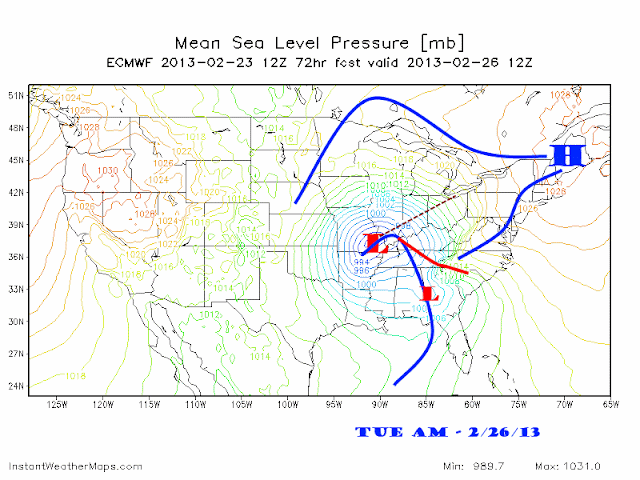


While preliminary data supports a more significant storm than this past Friday's weakening storm, questions still arise as to the nature of the precipitation. At this time; the best estimates from the early data points to a mixed rain and snow scenario to arrive Tuesday afternoon before changing to all snow sometime Tuesday evening lasting into Wednesday. Heavy amounts of snow are possible with this system especially if the majority of the precipitation received is, in fact snow. Since this time period is still 3 - 4 days out and as you know in this business; things can change - but look for updates on the progress of the system into Tuesday.

Making weather fun while we all learn,
Bill Deedler -SEMI_WeatherHistorian