Mar 11, 2012

Winter Temperature Review/Spring 2012 Outlook For Southeast Lower Michigan

La Nina 2011-12 is fast becoming a memory as Pacific water temperatures warm back to Neutral (near normal or long term average) conditions.


Projected ENSO Model Data


Neutral conditions are expected to take hold during the spring and continue into the summer. In Neutral conditions, little if any effects from ENSO are anticipated across the country. That being said, I expect our La Nina pattern to fade as a "the song is ended but melody lingers on" type of pattern for the near term with the atmosphere still reeling from some of the La Nina effects. I feel we are seeing a good example of this with the recent notable early severe weather across the center and southern portions of the country. La Nina's do tend, on average, to be busier in the severe weather department.

Of course; the strongest influence by far on our weather continues to be the NAO/AO oscillation which has been nearly consistently positive since last Autumn (check it out; Fig -1 below). This was the main reason the winter was so mild as explained in earlier blogs. Looking at the Winter 2012 preliminary statistics at Detroit all data includes leap day, 2/29.

Detroit
Ave High:  39.5                                                 Precipitation
Ave Low:  26.4                                                 7.70"/ +1.26
Wntr Ave: 33.0 /6th warmest/                       Snow thru 2/29th
 (warmest winter since 2001-02 @ 33.8)    25.8"/-8.3"

Flint
Ave High:  38.1                                                 Precipitation
Ave Low:  24.2                                                  5.85/ +0.82
Wntr Ave: 31.2 /5th warmest/                        Snow thru 2/29th
 (warmest winter since 2001-02 @ 31.7)     32.3"/-6.3"

Saginaw    
Ave High:  36.9                                                  Precipitation
Ave Low:  24.2                                                  5.85/ +0.82
Wntr Ave: 30.6 /3rd warmest/                        Snow thru 2/29th
(warmest winter since: 2001-02 @ 30.5      41.9"/+7.6
                                  1997-98 @ 30.9)
_______________________________________________________________________

                                                                                  Fig -1
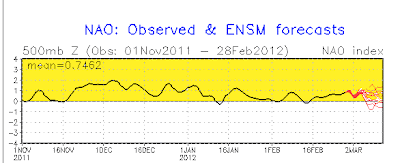

With the NAO remaining positive throughout the winter, the dominant analogue winters were virtually useless. The last time a winter was so "contrary" to popular analogue opinion and Outlook was back in the Winter of 2001-02. Interestingly, the "popular call" that winter was also for below normal temperatures; instead it too turned out to one of the warmest winters /5th/ on record in Southeast Lower Michigan and much of the country. While this past winter was a La Nina winter, the Winter of 2001-02 was a Neutral Winter that subtly evolved toward a El Nino late winter (but ENSO's influence too, like this past winter was negligible). The trump card in any winter season on the temperature side and lesser extent snow of course; is the prevailing phase of the NAO/AO!
 
There were two coincidences between these two winters one straight forward and one; conjecture and controversial. It was suggested in some scientific papers written about the 2001-02 winter and the questionable strong solar flare influence on the planetary winds. As in the past winter, the NAO also remained strongly positive for much of the Winter of 2001-02 which certainly accounted for the largest mild impact on the winter then and now!  This near term peak in solar flare activity (relative to recent trends) during this past fall and winter; albeit weaker in strength, is just an intriguing parallel between the two winters and accompanying solar flare periods, and of course like 2001-02, research would have to be done.

Ironically; as I go to press the strongest solar flare episode since late 2004 had just been reported.

While on the subject of solar activity another very interesting article was written by Joe D'Aleo on the recent minimum solar activity, before the sun's latest burst into its 23rd cycle. I personally feel more research should be done on the correlation between sun spot activity and weather and climate patterns on earth.

From Wikipedia on this particular subject:

Solar Variation and Weather

There are some suggestions that there may also be regional climate impacts due to the solar activity. Measurements from NASA's Solar Radiation and Climate Experiment show that solar UV output is more variable than the total solar irradiance. Climate modelling suggests that low solar activity may result in, for example, colder winters in the US and southern Europe and warmer winters in Canada and northern Europe, with little change in globally-averaged temperature. More broadly, links have been suggested between solar cycles, global climate and events like El Nino. In other research, Daniel J. Hancock and Douglas N. Yarger found "statistically significant relationships between the double [~21 year] sunspot cycle and the 'January thaw' phenomenon along the East Coast and between the double sunspot cycle and 'drought' (June temperature and precipitation) in the Midwest."

Recent research at CERN's CLOUD facility examined links between cosmic rays and cloud condensation nuclei, demonstrating the effect of high-energy particulate radiation in nucleating aerosol particles which are precursors to cloud condensation nuclei. Dr. Jasper Kirby, a team leader at CLOUD, said, "At the moment, it [the experiment] actually says nothing about a possible cosmic-ray effect on clouds and climate, but it's a very important first step."

1983–1994 data from the International Satellite Cloud Climatology Project (ISCCP) showed that global low cloud formation was highly correlated with galactic cosmic ray (GCR) flux; subsequent to this period, the correlation breaks down.Changes of 3–4% in cloudiness and concurrent changes in cloud top temperatures have been correlated to the 11 and 22 year solar (sunspot) cycles, with increased GCR levels during "antiparallel" cycles. Global average cloud cover change has been found to be 1.5–2%. Several studies of GCR and cloud cover variations have found positive correlation at latitudes greater than 50° and negative correlation at lower latitudes. However, not all scientists accept this correlation as statistically significant, and some that do attribute it to other solar variability (e.g. UV or total irradiance variations) rather than directly to GCR changes. Difficulties in interpreting such correlations include the fact that many aspects of solar variability change at similar times, and some climate systems have delayed responses.

Spring 2012 Outlook

Temperatures:
Look for temperatures to average mainly above normal during the Spring of 2012. The strong NAO/AO+ pattern of the fall-winter continues to dominate as we move into spring-time.

Precipitation:
Rainfall during the spring and especially summer is more variable; occasionally areas of above, below or around normal can exist in the same season over a relatively small area. During the Spring of 2012; I look for precipitation to average normal to above normal across much of the region.

Severe Weather:
Since a strong jet stream is an important ingredient for severe weather, the position of the jet stream determines the regions more likely to have severe weather.

Contrasting El Niño and La Niña winters, the jet stream over the United States is considerably different. During El Niño the jet stream is oriented from west to east over the northern Gulf of Mexico and northern Florida. Thus this region is most susceptible to severe weather. During La Niña the jet stream extends from the central Rockies east - northeastward to the eastern Great Lakes. Thus severe weather is likely to be further north and west during La Niña than El Niño. As stated above; while La Nina conditions over the Pacific are disappearing, a La Nina-like scenario would bring at least average to even above average severe weather to the region.

Spring Analogues:
As mentioned, analogue data was virtually useless with the main driver of the winter the NAO+/AO+. However, in the analogues years where the patterns seemed the closest to our recent mild winter conditions and prevailing NAO+/AO+, the springtime temperatures and precipitation are shown below. In addition, included is the the springtime precipitation for all the previous winter analogues. The data maps show the warm weather continued to prevail from the Plains eastward across the country. Below normal temperatures were found out west. Overall; precipitation averaged normal to above east of the Mississippi in both sets of years of the analogue data.


Making weather fun while we all learn,
Bill Deedler -SEMI_WeatherHistorian


Mar 2, 2012

Intensifying Low Pressure System Moving Into The Region /Epilogue 3-3-12/

Epilogue:
A list of peak winds is worth a thousand words with peak gusts right in the 50-55 mph predicted range. Hope your power stayed on!

PUBLIC INFORMATION STATEMENT
NATIONAL WEATHER SERVICE DETROIT/PONTIAC MI
750 AM EDT SAT MAR 3 2012

THE FOLLOWING ARE SOME PEAK WIND GUSTS REPORTED TO THE NATIONAL WEATHER SERVICE TODAY...
AS OF 730 AM...

DETROIT METRO AIRPORT            55 MPH     111  AM...
ANN ARBOR                        54 MPH     916  PM...
FLINT                            53 MPH     157  AM...
DETROIT CITY AIRPORT             53 MPH     1155 PM...
OWOSSO                           53 MPH     215  AM...
PONTIAC                          52 MPH     1202 AM...
YPSILANTI                        52 MPH     1034 PM...
CARO                             52 MPH     1224 AM...
ADRIAN                           51 MPH     913  PM...
MOUNT CLEMENS                    51 MPH     223  AM...
MONROE                           51 MPH     1113 PM...
SAGINAW-HARRY BROWNE AIRPORT     48 MPH     311  AM...
BAD AXE                          47 MPH     515  AM...
SAGINAW-MBS AIRPORT              46 MPH     1148 PM...
GROSSE ILE                       46 MPH     1034 PM...
TROY                             45 MPH     1114 PM...
PORT HOPE                        44 MPH     124  AM...
LAMBERTVILLE                     44 MPH     855  PM...
PORT HURON                       40 MPH     257  AM...
MIDLAND                          37 MPH     434  AM...
 
BTW: A pic is also worth a thousand words: This pic was taken
by Josh Halasy over Northern Michigan in Grayling 3/3/12.
 
What Southeast Lower Michigan Missed:


---------------------------------------------------------------------------------------------------------
Original Blog 3/2:
A deep and intensifying low pressure will push through Lower Michigan overnight into early Saturday morning. This storm will bring wind blown rain and possible thunderstorms over much of Southern Lower Michigan this afternoon and evening; and heavy snow with near blizzard conditions over portions of Northern and Upper Michigan overnight. A strong cold front will pivot behind the center of the storm later tonight and bring much colder air along with snow showers to Southern Lower Michigan into Saturday. This is the same storm system that is currently (Friday afternoon, 3/2) bringing severe weather and tornadoes across the Ohio and Tennessee Valleys.

The rain and snow over Michigan will be accompanied by strengthening winds into the evening and overnight. Peak sustained southwest to west winds of 30 to 40 mph with gusts possibly as high as 50 to 55 mph are expected from late this evening into early Saturday across all of Lower Michigan. The central pressure of this intense cyclone is expected to plummet to around 976MB /28.80"/ by Saturday morning (map; below) as it pushes northeast from Lower Michigan to just east of the U.P.


Travelers and interested parties can get additional weather forecasts from the NWS across Michigan here at White Lake /DTX/, Grand Rapids /GRR/, Gaylord /APX/ and Marquette /MQT/.

Making weather fun while we all learn,
Bill Deedler -SEMI_WeatherHistorian

Feb 28, 2012

Wintery Mixed Precipitation to Accompany Warm Air Advection Wednesday

Epilogue:
System behaved itself with generally light amounts of snow and sleet reported over northern areas of Southeast Lower Michigan; and a bit of snow with more sleet and freezing rain central and southern areas. Most of the freezing rain was over central areas of the region with ice totals remaining below a 1/4".

http://forecast.weather.gov/product.php?site=DTX&issuedby=DTX&product=LSR&format=CI&version=2&glossary=0

http://forecast.weather.gov/product.php?site=DTX&issuedby=DTX&product=LSR&format=CI&version=1&glossary=0

blog:
At this time, it looks as though central and northern Southeast Lower Michigan...or a line roughly from north of Ann Arbor into Detroit's northern suburbs and areas northward...could see the longest period of mixed precipitation before the changeover. While light amounts of snow, sleet and freezing rain are expected, the sleet and freezing rain will be most problematic with ice amounts less than 1/4" in freezing rain areas. 

=====================================================
Initial blog below:
Look for weather conditions to deteriorate after midnight during the early morning hours of Wednesday /29th/ as strong warm air advection aloft pushes into Southern Lower Michigan. This increasingly moisture-laden warmer air will trigger snow, then sleet and freezing rain as it rides over the colder air at and just above the ground. The storm center bringing the snow, sleet and freezing rain will move west of the region over southern Minnesota but will act as a pin-wheel; advecting the warmer, moist air into the region from the south. Blizzard conditions are expected out over the Upper Midwest with heavy snow into the Northern Lakes with this storm.


Much of the mixed precipitation should fall from the early morning hours into the forenoon hours of Wednesday as it moves in from the south and works its was north. The mixed precipitation will change to light rain, drizzle with just cloudy conditions thereafter in the afternoon.  In addition, a moderate east to southeast wind will accompany the event. While there will be strong warmer air riding aloft; indications are the colder air near the surface will begrudgingly give way over portions of Southeast Lower Michigan. At this time, it looks as though central and northern Southeast Lower Michigan...or a line roughly from north of Ann Arbor into Detroit's northern suburbs and areas northward...could see the longest period of mixed precipitation before the changeover. While light amounts of snow, sleet and freezing rain are expected, the sleet and freezing rain will be most problematic with ice amounts less than 1/4" in freezing rain areas. However; this is subject to change if more moisture works in or change-over is delayed.

A sharp temperature-gradient will form over Southeast Lower Michigan on Wednesday with readings rising into at least the 40s behind the surface warm front, while hovering in the lower to mid 30s ahead of it. Look for the warmer air to overtake the entire region during the after as readings rise into the 40s, to around 50 in the south. Then; look for colder air and snow showers to move back into the region Wednesday night.

Motorists be advised driving conditions will deteriorate rapidly as the mixed precipitation encompasses Southeast Lower Michigan during the early morning hours while temperatures are at/or below freezing.

Making weather fun while we all learn,
Bill Deedler -SEMI_WeatherHistorian

Feb 21, 2012

Review of Winter Storm: February 23-24th, 2012

Epilogue 2/23-2/24/12 Storm:
Thursday 2/23 model runs on the system pivoted the storm further south than my initial projection across Northern Indiana and Northern Ohio.  In accordance; I raised snowfalls to 4" - 8" rather than the 2"- 4" with pockets of 3" - 6" forecast a day earlier on Wednesday. In retrospect, the low tracked closer to my original thinking; south of Tuesday's model projections over Illinois/Indiana but wound up further north of Thursday's model projections, over the corner of Southeast Lower Michigan early Friday. Just as important however, was the track of the upper air support which /vorticity max/ which tracked right across Southeast Lower Michigan. This was northwest of the surface low and provided maximum lift and dynamics for the system. Heaviest snow generally falls to the left (or north-northwest) of the vorticity center which was across Saginaw Valley into the Thumb (where 3" - 5" of snow with maximum pockets of 6" was observed). Heavier amounts were observed further northwest into central and northern Michigan.             
                                                      Snowfall Amounts & Map from DTX


What was learned in this event?
Just because they are the latest model runs (versions); doesn't mean they are the most accurate. Sometimes your earlier and initial analysis on a snow forecast is the better one and you must have faith to stick with it; even in the face of "model contrariness". On that premise, I failed by changing my original snowfall amounts Thursday. On the positive: I alerted the public of a storm that would impact Southeast Lower Michigan and the Great Lakes days ahead of the storm. The storm did develop and affected residents of Southeast Lower Michigan; in a winter that has been virtually "stormless"; see initial 2/21/12 blog below. 
===========================================================

Blog: 2/23
Latest indications continue to show the winter storm first written about here on Tuesday will indeed affect all of Southeast Lower Michigan as she tracks eastward and then northeastward through the Northern Ohio Valley. Nearly all the models now paint an intensifying cyclone, shifting from southern Indiana northeast through central Ohio and then toward the Cleveland area by Friday afternoon. This more southerly track is in accord with earlier thinking and then some with the track now proficient for the likelihood of heavy snow across much of Southeast Lower Michigan.

While the track will be south of Southeast Lower Michigan, enough warm air will be drawn up ahead of the system to bring rain or rain mixed with snow up into the region toward sunset across the far south and this will move northeast;  encompassing all of Southeast Lower Michigan during the evening hours. Much of Southeast Lower Michigan should receive 4" to 8" of snow with this system with the highest amounts likely north of I-94. Heaviest snow inducing lower visibilities should occur toward the midnight hour and continue through the early morning hours.


-----------------------------------------------------------------------------------
Earlier blog 2/22/12 of model and my positions:


 -------------------------------------------------------------------------------------------
Initial Blog: 2/21
Latest model trends are converging on an intensifying Eastern Great Lakes low pressure system late Thursday into Friday. This system will be brought about as strong Pacific energy aloft aligns with/and phases with Polar energy diving in from central Canada.

On to the particulars; Strong energy aloft at varying levels is projected to dive east southeast from the Pacific into the Midwest by late Thursday. At the 250 MB /35,000 Ft/, the core wind max is expected to be at least around 130 knots! This upper level energy will proceed generally east and align itself along a potent stationary frontal boundary that will form and extend from the southern Great Lakes east into Pennsylvania and then, off the East Coast. At this time it looks a though a few waves of low pressure will be induced along the front while rippling east with time. As this scenario becomes more established across the southern Great Lakes and northern Ohio Valley; additional moisture will be drawn northward from the Ohio Valley and then subsequently, westward from the Atlantic. This moisture, in conjunction with the strong upper level dynamics and surface boundary, will be aiding and a betting with the development of the main Eastern Great Lakes cyclone or low pressure system by Friday. How quickly this above scenario takes place will have a lot to do with the final outcome of the weather to affect Southeast Lower Michigan.

On the projected 7 pm Thursday weather maps below; 

Map 1 from the GFS model denotes the 250 MB wind jet at 35,000 feet and speeds. The first jet core /1/ will help with the initial development of our frontal boundary and low pressure system as phasing commences; while the second jet core /2/ comes in from the rear to deepen and intensify the system during the day Friday. The second GFS map places the main developing low pressure near the tri-state area of Michigan-Indiana-Ohio also at 7pm Thursday. I feel the GFS may be too far north with the main surface low and its track could be further to the south; over the northern half of Indiana and Ohio rather than the border area.

                                                                          Map - 1


                                                                              Map - 2


Of course, this a projection of a few days out and therefore will be attentively watched and analyzed as updates from various models zero in on this system. Not only do the usual problematic winter storm specifics apply here; such as track and available moisture but also the temperatures in the lower levels of the atmosphere and surface which will dictate initially the amount of rain and snow and later, potential snow accumulation. At this time is does look as though the worst of the system will be east of Southeast Lower Michigan but it still bears watching, so stay tuned.


Making weather fun while we all learn,
Bill Deedler -SEMI_WeatherHistorian

Feb 7, 2012

Another Arctic Air Pest To Visit For The Weekend / Epilogue-2-11-12/

The Forecast:
"The very latest indications are enough moisture will be transported into Southeast Michigan as a weak wave of low pressure transverses the front (see second map) to bring 1 to possibly 3 inches of snow across the region. Gusty north winds and falling temperatures later on Friday will exacerbate driving problems. Motorists driving Friday up through Michigan should be prepared for this winter weather and any subsequent lake effect snows with higher amounts."

Epilogue: System was a bit of a overachiever as she wound up in the eastern lakes feeding on the better moisture as the Arctic cold wrung out the moisture. Generally; a one notch higher 2-4" category would have been the most accurate call (some isld 5"s ). Overall, my Friday AM forecast did indicate the stronger trends, along with the timing and driving conditions being spot on. Enjoy the winter wonderland this weekend; now on to the next challenge.....

recent snow amounts /per NWS/
Snow map

----------------------------------------------------------------------------------------------------------------------------------------------------
 Previous blog:
In a winter where true Arctic air infiltrations (a.k.a. pests this winter ;-)) have been as rare as its snowstorms, an impressive plunge of Arctic air will again be our weekend guest, arriving this Friday. Ironically, it was exactly a month ago in January on Friday the 13th, when the first in a series of Arctic waves surged south into the Great Lakes. In any other winter, these plunges of Arctic air and resulting temperatures would not be very noteworthy but given the extraordinary mild winter thus far, they are and it will be noticed! High temperatures will actually drop to below normal levels for a couple of days in the teens and 20s. Normally as we move into the second week of February, our highs across Southeast Lower Michigan average in the 30 to 35 degree range while lows place between 15 to 20.  


                                                   250 MB Upper Jet
                                                                       Surface Map

Likewise as in that first mid January visit, this new Arctic air pest will take its harshness out on the inhabitants of Southeast Michigan late Friday into Saturday but then; quickly begin to slide off to the northeast as the weekend comes to a close on Sunday. Snow showers and squalls we also accompany this latest blast (as it did back in January). The very latest indications are enough moisture will be transported into Southeast Michigan as a weak wave of low pressure transverses the front (see second map) to bring 1 to possibly 3 inches of snow across the region. Gusty north winds and falling temperatures later on Friday will exacerbate driving problems. Motorists driving Friday up through Michigan should be prepared for this winter weather and any subsequent lake effect snows with higher amounts.


                                                                        Surface Map


After this weekend, indications are the action will focus back to our southwest early in the week as the Jet Stream begins to re-group out over the Plains. At this time it looks as though some light snow or mixed precipitation may move back into the region toward Valentine's Day.


Making weather fun while we all learn,
Bill Deedler -SEMI_WeatherHistorian

Jan 25, 2012

Strong Solar Storm Arrived Tuesday 1/24/2012...Auroral Forecast From NOAA

A strong solar storm arrived in the earth's atmosphere on Tuesday morning. An neat experimental web site from NOAA's Space Weather Prediction Center does an auroral forecast which displays where the Aurora Borealis (or northern lights) are expected based on solar wind and the interplanetary magnetic field /IMF/.

Also; check out these Aurora Borealis vidoes, courtesy of You Tube and The Inquisitor.

Making weather fun while we all learn,
Bill Deedler -SEMI_WeatherHistorian

Jan 22, 2012

Mid-Winter 2011-12 Update...What Has Been Going On and What to Expect The Remainer of The Winter

             Written by: William R. Deedler, Weather Historian Southeast Lower Michigan
                                                                    1/22/2012

Well this has certainly been a difficult winter to initially forecast; then observe. Some of the main issues I stated in the Outlook and subsequent blog troublesome winter have unfortunately materialized. 

From the Outlook:

The Ever Elusive NAO/AO
The other main ingredient in this winter’s weather (like any other) is of course, 
the trend of the North Atlantic Oscillation/Arctic Oscillation throughout the winter. 
Of course, this is the biggest challenge to the forecast and potentially, has the 
biggest bust potential. While trends with La Ninas and El Ninos are seen (and 
these are not always consistent, either) the NAO is highly elusive and generally
trends are seen only a week or two out. The near term has been neutral to positive
reflecting the recent mild weather but what of the projected? Seems as though
the model ensembles are having a bit of trouble.

The first and utmost problem with this winter is one of the main issues every winter, the North Atlantic/Arctic Oscillation phase. Most forecasts this winter were counting on a negative or at least neutral average of the NAO like the past several winters but this surely has not been the case. The NAO/AO has been in positive mode (sometimes strongly) since last fall. Of course when the NAO/AO is in a positive mode or phase, the real Arctic cold air remains bottled up around the polar regions and other far northern latitudes; one of the reasons why Alaska has been so cold and stormy this winter. In the strongly positive NAO/AO phase, basically the Arctic Jet stream retracts northward somewhat as it circumnavigates around the North Pole. It has been only recently where the NAO/AO has been transitioning toward a neutral or occasionally, a negative phase. It is interesting to note that the projected phase of NAO/AO is mainly neutral-negative early, then becomes quite variable again but with a subtle trend downward as of 1/21/2012. One positive note in this recent transition is the fact it does reflect the Winter Outlook's analogue's call that the second half of the winter would contain the worst of the weather: being the coldest part of the winter and back-end loaded with snowfall. Of course the obvious question that arises; will the NAO/AO trend continue?


The second reason why much of the lower 48 and Southeast Lower Michigan have been mild is also the reason Alaska has been so stormy: the strong northern Pacific Jet Stream discussed in the Outlook and later in the Troublesome Winter. This part of our Winter Outlook equation is there, in spades. The jet has been so strong, occasionally it established a strong zonal flow into the US, ironically not unlike the jet seen in moderate to strong El Ninos; just further north. The analogue projected Pacific Jet "did it's part" to verify our expected winter jet pattern but it's partner, the Arctic Jet in which phasing or pardon the expression, "mating" was routinely expected but has occurred, infrequently. Therefore, much of the country has actually experienced in my opinion a "pseudo El Nino" winter with the strong Pacific jet bringing modified air into the country. In addition, many times this strong jet off the Pacific dug into the West and actually creating ridging into the center and eastern part of the country in the absence of the Arctic Jet.  This in turn; brought periods of above to well above normal temperatures. So much so, that up until recently Southeast Lower Michigan had experienced perpetually late fall-like temperatures with readings the first half of the winter averaging a good 5 degrees above normal!

Visualizing this further:
The Pacific Jet of the analogue's winter (Fig -1) upper wind pattern has been fairly accurate; while the Arctic Jet pattern has been focused further north across Alaska east into north and central Canada. It's interesting to note that between these patterns there was a notable absence of wind or "lighter wind path" west to east, across the center part of the country just north of sub-tropical jet. In the absence of the Arctic Jet, which has retreated north, one can visualize how the intense Pacific Jet would easily flood across the country in this basic analysis of the pattern (fig-2) (and remember to take into consideration the Arctic Jet being further north).

                                                                              Fig -1


                                                                              Fig - 2

Ok, this is the past and present; what about the future?

While we have definitely seen a pattern change of late, the NAO/AO is still in a transitioning or "unstable" pattern which has been even more erratic than usual, which makes forecasting the second half of the winter just as troublesome (or difficult) as the first. But, if you know me by my years with NWS and my Southeast Lower Michigan Outlooks (and now Weather Historian Blog), I'm not going to let a "little" adversity get in the way. If I fall on my face, so be it...it wouldn't be the first time nor the last. And, using the famous pep-talk line; "Get up and put one foot in front of the other and get on with it!" ;-)

Temperatures:
Well, obviously taking into consideration the first half of the winter, my original call of 1 to 3 degrees below normal was much too cold. Therefore, adjusting for the exceptional warmth first half of the winter (with an average departure through mid January of +5.0) , I now expect the entire winter average temperature to range 2 to 4 degrees above normal. With these departures, one would expect the second half of the winter to be colder than the first half but I still look for it to average around 1 to 3 degrees above normal.

Snowfall: 
The snowfall issue was visualized and foreseen in the original Outlook:

"The ranges of snow each month (from the analogues) is extraordinary with some ranges two to nearly three feet. Just in February alone: Detroit ( 2.6" to 31.7" ), Flint (1.5" to 31.4") and Saginaw ( 3.7" to 34.2"). This handily shows this incredible range of snowfalls. Really, the only thing I can gather here is that these set of winter's seemed to be more back-end loaded with the worst of the winter coming the second half."

"If the storms ride further north than expected, this could also botch up the temperature forecast too with the upper level ridge holding stronger in the Southeast."

The second quoted line here has happened and mainly due to the positive NAO/AO and subsequent retreat of the Arctic Jet. My original snowfall call here was normal to above snowfall and thus far, most areas have seen around 6-10" below normal (and one decent storm would take care of that); whereas the Saginaw Valley region has had about normal snowfall.

Taking all this into account; I look for the majority of the region to still see close to normal snowfall (within 6") but with a few areas above that mark and a few below.

Making weather fun while we all learn,
Bill Deedler -SEMI_WeatherHistorian